Not All Teenagers Are Wild

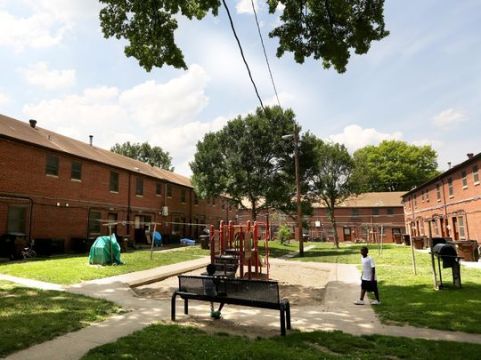
Peter Knoll Homes Newport
Peter Knoll Homes, Newport KY

While we were always a low-income family, after my father went to prison, we became destitute. My family moved to Peter Knoll Homes, a housing project in Newport Kentucky. These projects were built at the confluence of the Licking and Ohio Rivers and were prone to annual flooding. My mother received a meager child welfare allowance and food commodities to feed us. This was years before food stamps and commodities included foods like wheat and corn flours, butter, cheese, dried beans and canned meat. Our mother sold the cheese for extra cash, and we frequently went to bed hungry. She also spent most of the monies intended for clothing and her children’s other needs drinking in the local bars.

My mother resented and punished me for “breaking up our family.” Somehow, it was not my father’s fault for abusing me. It was my doing for reporting the abuse to the county child welfare worker. It was all my fault and my mother and older sister, Liz, reminded me frequently. A local boy who was dating my sister raped me. That was “my fault” too.

After years of chronic abuse, I suffered from what I now know was Post Traumatic Stress Disorder. I suffer to this day. I was timid, anxious, depressed, and my affect was flat. I lived in a state of isolated terror and frequent tachycardia. Just before I turned 13, the child welfare worker understood how critical my situation was, and she placed me in a school for girls, Our Lady of the Highlands in Fort Thomas, Kentucky. I never again lived with my family, and over the next few years, my mother had all of her children taken from her.
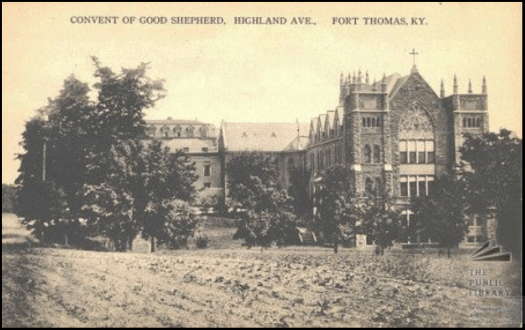
OLH3.psd
Our Lady of the Highlands, Ft. Thomas, KY

At Our Lady of the Highlands I did not have to fear physical or sexual abuse, but no matter how hard I tried, I could never be like the other girls. I was too slow making my bed, brushing my teeth, getting dressed; tasks we had to complete in firmly enforced time limits- and in complete silence.

The silence felt like a protective shroud. If I did not say what I thought or felt, it could not be used against me. In the three years that I was at Our Lady of the Highlands, I did not make a single friend. Of course, friendships were discouraged for fear of the girls forming homosexual attachments.  We also could not talk about our lives or experiences before we came to the school. That was fine with me because I feared that if they knew what had happened to me; if they knew about the sexual abuse or the rape, then they might think I was worse than trash. I felt sullied, unclean and tarnished. How could anyone ever like or love me if they knew the truth?

After three years, I entered a foster home in Ohio. I was fifteen, and for the first time, I could be just another teenage girl. Next door lived the foster mother’s sister-in-law and her four children.  Their daughter, Judy, whom I thought of as a cousin taught me how to dress, how to dance, how to laugh. We would sing to Martha and the Vandellas and other songs. The months chumming with Judy and her brother Randy were some of the fondest memories I have to this day. My happiness, however, was short lived. I danced with a black boy at the school homecoming dance and was suspended for a day while the school notified my guardians.

Right after that, I was awakened one morning by my foster father before anyone else was up and told to pack. He loaded me into his car and drove me back to the child welfare office in Newport. I was not permitted to say goodbye to anyone.  My foster mother was ill, and I did most of the cleaning and cooking. I did everything they asked of me. Why? Was I impossible to love? To trust? I was devastated.

I was sent to live with friends of my mother and father in Pennsylvania. The wife, whom I will simply refer to as Aunt F, was never happy with me or with my sister, Marie, who also lived there. I no longer made straight A’s in school. I came straight home from school every day and Marie and I cleaned, washed, folded clothes, in short, did all of the housework for a family of five not including me and Marie.  It was never enough, and Aunt F frequently grounded us for slight infractions of the rules. I lived with the family for two years, and that did not end well either.

I did have a boyfriend, a boy from my Aunt’s church. We were permitted to go to the movies twice a month with an early curfew, but once again, I did not have any friends. Friends got together after school or on weekends, visited each other in their homes, but I was not permitted that luxury. I had housework to do.

Billy-Burke and me 1968
Me and boyfriend, Billy in 1968.

I was submissive, obedient and rarely complained. I feared that if I misbehaved, I would be put out again. My instinct was right. I lived with that family when my mother died.

On the day that my mother died June 1968, my sister and I were grief struck, and Marie did not want to eat dinner. Aunt F insisted that she eat, and Marie answered, “I don’t want to. I’m not hungry.” Aunt F slapped her across the face and screeched, “Don’t you ever talk back to me! Now do as you are told!”

I don’t know what came over me, but I jumped up from the table, grabbed Aunt F by the throat, lifted her off the floor and pinned her against the refrigerator. I did not raise my voice and said quietly but emphatically, “Her mother just died! If you ever touch my sister again, I will kill you!” In a surreal way, I can still picture her feet kicking frantically above the floor.

Uncle B calmed every down, and I was amazed that Aunt F and Uncle B did not punish me for what I had done. Aunt F avoided speaking to me for weeks, and when she did, it was to tell me that she was sending me to Indiana to live with my father. My father? The same man who had abused me?

That marked the end of my teenage years. When I arrived in Indiana, I had to quit school and get a job to help support my family. Marie came to Indiana too.  Liz, my older sister, lived with my father already. She was pregnant and insisted that at five months, she was too sick from pregnancy to work. My dad earned $1.60 an hour, not enough to support a family of four, so it was up to me to get a job.

No school dances for me. No Martha and the Vandellas or Beatles. I worked until that arrangement too fell apart. These were my teenage years.
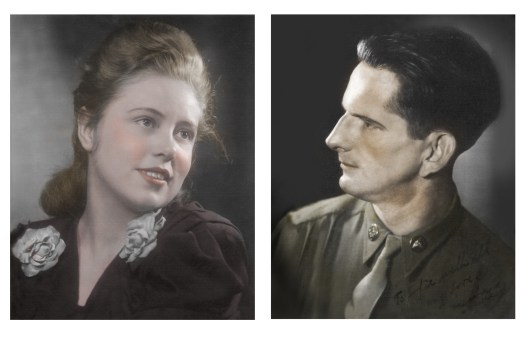
A Little About My Parents…


combine
Sofie Schneider and Harry Riley mid 1940’s
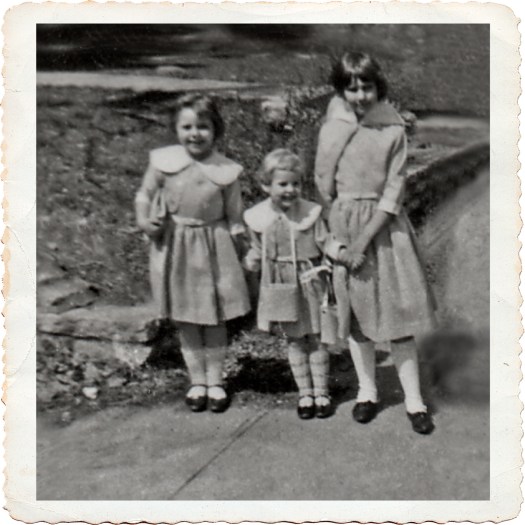
Marie_Erike_Dottie_1961
Marie, Erika and Dottie Riley, 1960, Cincinnati, O
I never talk about my parents. They were a disappointment, but more than anything, I feel deeply sorry for them.

My father never knew his mother or anything about her.  Where memories should have been, my father filled the holes with fantasies and confabulations. My father wove myths, lies, and fantasies throughout his life. I knew that as a child but had to relearn that lesson several times as an adult. I could write pages detailing the numerous tales he told, but that is not the focus here. Self-deception is how he coped with conflicts and inflated his wounded ego.

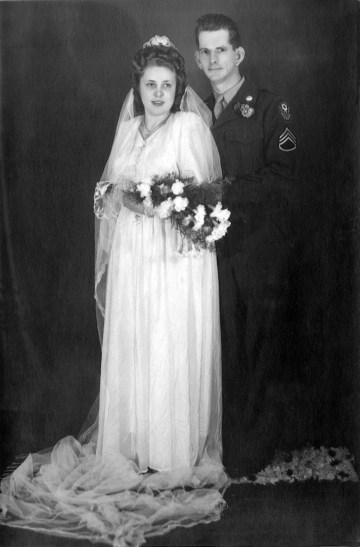
My mother was the oldest of two children born in 1925 to Elizabeth and Otto Schneider, residents of Nuernberg, Germany. At nineteen years old she married Erich Ansteeg, reportedly a member of Hitler’s SS. My mother said he was cruel and violent. They divorced a little more than two years later. Less than a year after the divorce, during the Allied Occupation of Germany, she married thirty-two-year-old Staff Sergeant Henry Riley, a member of the U.S. Army. In a war-ravaged country with no luxuries available, my mother, a talented seamstress, sewed her wedding gown out of a silk parachute that my father got for her.

Harry and Sofie wed copy

Ansteeg fathered my oldest sister, Elizabeth. Liz suffered from polio, and my mother turned to Harry (Henry) for medical treatment that was unavailable to German citizens. Soon after their marriage, the Army transferred Sergeant Riley back to the U.S.A. with his new family, and sometime after that, he was discharged.

I know from talking to my (second) cousin that my father took his family back to Newport where they briefly stayed with his cousin. They disappeared without explanation. Gordon got up one morning, and my father and his family were gone, and his parents and aunts and uncles refused to talk about it. That was the last time my cousin saw or heard from my father (his first cousin). When we talked about it many years later, Gordon and I could only speculate about what might have happened. My guess is that he was caught sexually abusing Liz or one of the younger children.

Harry reenlisted in the Army in 1950. Over the next few years, he was stationed in the San Francisco Bay area where Marie and I were born, and Ft. Huachuca, Arizona. He re-enlisted in the Army Reserves and was stationed in Germany after my grandfather suffered a severe heart attack. My sister, Erika was born in Nuernberg. Upon his return to the U.S., Harry was still enlisted in the Reserves assigned to Fort Campbell, Kentucky.

Funny thing. When we returned to Newport in the 1960’s, my father always insisted that he had no family. I discovered decades later that we had cousins and their families living just a few blocks from us!  I cannot explain that.

My father worked as a janitor and maintenance man. He had a full-time day job and worked nights cleaning offices. Even with two jobs, we barely scraped by. We did not have a telephone, but someone had given my father a black and white TV set with a snowy image. That TV with its rigged antenna held a central position in our living room.

My father’s poverty must have been a bitter disappointment to my mother. She came from an affluent German family who managed to hold on to their business until 1944 when the Allies bombed it. After the war, my grandfather became quite wealthy as a painting contractor and rebuilding Germany made that a most lucrative enterprise.

Mom could never accept her diminished social status. She didn’t lie like my father, but she bragged about stupid things to the point of embarrassing us. Her most frequent boast was about how we were going to be millionaires after our grandparents died. Mom had no way to foresee the events that would unfold between 1963 and 1968. She never experienced anything during her last years except pain, humiliation, and bitter poverty.

In 1963 I reported the sexual abuse I suffered by my father. My mother did not believe me even after my father confessed to ‘carnal knowledge with a minor.’ My mother became cruel and degraded me. My mother encountered a former friend while standing in a checkout line in a grocery store. She said to the friend, “That’s the hussy that lied about my husband.” I was but twelve years old. Other times, she referred to me as “the hussy who stole her husband.”

After my father went to prison, my mother quickly turned to drink, and severely neglected her children.  We were eventually all placed in foster homes and institutions.  My mother followed her new man to Pennsylvania where she thought she had friends and where she died June 23, 1968, of a heart attack. She was only 43 years old.

My mother had several harrowing war experiences, but these too are fodder for future stories. She was not evil. She simply could not cope with the consequences of choices that she made under very trying conditions, and her brother and parents were no help. As far back as 1959, Mom wanted to leave my father, but her parents would not hear of it. Of course, they had no way of knowing what he was doing to their granddaughters, and I doubt if my mother would ever have admitted the truth to them. More than anything, I pity my mother.

Family Myths and Lies

FamilyMythsandLies-WP

My family is rife with myths bordering on alternate realities. Some people might think the stories they repeat are lies. Until recently, I did too, but what is a lie? Anything that is not true, not factual? That is an over-simplification.

Take a look at the current political climate. People firmly believe in candidates and positions that are refuted by facts. Beliefs are not connected to truth, and when they are, it is almost by accident. We hold to facts that support our beliefs and dismiss all others. Families do that too, and family myths are as difficult to alter as religious beliefs. Take my own family, for example.

My father was an enigma. He was loving and affectionate. Were it not for him I would never have known love at all, and yet he abused me for most of my childhood.  My father was a master at weaving myths into the fabric of our lives. His mother died when he was a toddler, and his father and grandparents raised him. He told us that his mother, a Cherokee Indian, was killed by an Indian man to whom she was promised in marriage. Of course, he told us that she was no common Indian maiden but a Cherokee princess. While I dismissed the princess part before I was an adult, he always insisted, and we always believed that she was Cherokee, or at the very least, half Cherokee by birth. That, we believed, is from whom my father inherited his high cheekbones and the slight hook in his nose. He told my mother the same thing, and she too believed that her husband was part Native American until the day she died.

When my younger sister, a dual national, had to declare her citizenship, she obtained a copy of my father’s birth certificate as part of her naturalization process. I was in my mid-thirties when I first saw this document and saw that his mother’s race was listed as ‘white.’ White? How was that possible? In 1916, no native American would be listed as ‘white’ on a birth or marriage certificate. My world dropped out from under me. A piece of my identity had been ripped from me and left me questioning everything I ever knew or believed about myself and my family.

You see, this was just another myth constructed by my father. He had two names and two birth dates and always used ‘Gordon’ as his middle name. After he had died, I learned that he never had a middle name at all, and his tombstone at the Veteran’s cemetery bears the wrong first name; the only name by which  I knew him. He told countless myths, and my sisters and I used to laugh at most of them, but we never guessed that even his name and ethnic origins were constructive lies.

My mother was not given to spinning yarns, but my sisters were good at it. Heck, I spun a few of my own until I saw my father’s birth certificate. After that, I resolved never again to alter any fact in my life no matter how much the truth made me squirm. There are things that I will never tell a soul, but I will never knowingly lie. I came to believe that no truth could be as hurtful as the myths and lies I’d been told.

My oldest son’s father, my first husband, rivaled my father in confabulating alternate realities. Walter shared other characteristics with my father: he was affable and charming, and just like my father, he abused the ones he loved most. Walter had a quirk that my father did not. He was too insecure to share affections. It was as if he feared that to love someone else meant that person loved him less. For example, as proud as he was of his son, he accused me of loving our son more than I loved him and was jealous of the attention I paid our son.

I had grown accustomed to Walter’s many stories and learned to separate the myths from the facts by talking to his mother. After our divorce, I no longer cared about his self-aggrandizing stories but that is when they did the most harm. The combination of distorting truths and weaving tales of near mythical proportions, paired with his insecurities and his need to be loved more made him draw our son into his fictions. There were no versions in which he was not the victim of my malevolent deeds.

I learned later that Walter liked and praised me to others. He told them how smart and talented I was and valued the few pieces of my artwork that he kept after I left him. Nearly two decades and three wives after we parted, I saw floral arrangements and drawings in his house that I had made. How they survived his subsequent wives is puzzling, but there they were! It would seem that he reserved his rancor of me only to ensure his son’s love. To be more precise, that his son loved him more than he loved me.

Like my father and like his father, my son lives in a world filled with myths and inventions. In his confabulations, he was raised by his grandmother, and I had no time for him; I am the reason his father took drugs; I destroyed his life, and I did not love him as much as I loved his younger brother. Like his father, Michael feared that my love for my youngest son meant that I loved him less.

The myths within my family have done nothing except hurt us, and yet oddly enough, they are constructs meant to avoid pain. Until very recently, I thought of these myths as venomous lies and detested them.  Then I had a eureka moment. Every person in my family who rewrites history and presents alternate facts is doing so to help them fill a painful gap or patch together pieces of their lives torn by tragedy and disappointment.

My father resorted to confabulation after her lover murdered his mother. In 1918, that was so scandalous and shameful that no one was allowed to talk about her in front of him. My father grew up with more questions than answers and resorted to creating his version of his mother, and ultimately his version of himself. His myths shaped his reality.

My sisters grew up with an abusive father, dire poverty and a mother who looked for solace in the bottom of a beer bottle. We were sent into foster homes and institutions, and everything about our lives was torn and sullied. This is not the childhood they describe to others. They will admit to our mother’s alcoholism and our destitute conditions as if they were but footnotes in their greater adventures.

My sons also knew trauma and rejection. My oldest son has his father’s ability to rewrite history and recreate reality to avoid inner conflict and pain. Most of Michael’s myths and distortions center around me, beginning with the lies his father told him. What is most interesting is how these myths and lies snowballed. They started with occasional hiccups in our relationship and culminated in a breach so wide neither of us can reach across anymore.

Back to my eureka moment. I now understand that every myth, every yarn is there to piece together a torn life. They are stitches and patches that make life endurable; that make it wearable. I wonder- if they deeply and honestly questioned themselves, could they admit that these are myths, or have they deluded themselves into believing they are truths? It also makes me wonder what myths I incorporated into my version of reality and what those myths might be.

Visiting Family

The death of my friend, Karen changed my outlook-or at least spurred me into acting on feelings already present. Before her death, I already felt as if life was passing me by and I was stuck in one place, which was in front of my computer. I spent so much time at my computer because I created publications for the US Coast Guard Auxiliary. They won awards and my skills were recognized at national level, but it was my entire life with room for nothing else. My life revolved around submission and publication deadlines, chasing down photographs, editing articles and laying out issues as beautiful as I could make them given the subject matter; men and women of the Auxiliary assisting the Coast Guard in their tasks.

That was before… Now, I am resolved to visiting family and seeing people that are important in my heart. I have mended fences with my sisters in Indianapolis and I’m truly enjoying being with them. I am so proud of all of them. My niece, Johanna and her husband, Gerome, have a beautiful home and three gorgeous grandchildren. Years ago, I was sincerely concerned because her daughter, Taylor, I thought married too young. I had hoped that she would attend college but she married soon after high school to her high school sweetheart, Demone. Turns out they are terribly happy, have three children and just last year, bought a beautiful home. Demone graduated college and is working on his Masters degree- all while working full time to support his family. Did I mention that he is a very likable guy to boot?

I am concerned that while I am the oldest, I am in better health than my two younger sisters. Marie, Taylor’s grandmother and the middle sister, has undergone numerous back surgeries while Rickey, five years my junior, is a physical wreck. I am not prepared to deal with another loss.

My sister, Rickey (Erika) lives in a house I bought twelve years ago. Marie once lived there too and while she was there, the house was well maintained. Now, it needs thousands in maintenance and repairs. Rickey and her friend that she shares the house with can’t keep up with basic yard work and cleaning due to both their disabilities and because they have never owned a home and cannot connect the dots between property neglect and home value. It is frustrating to me because they could easily call plumbers, electricians, etc., but they don’t. I pay for all repairs so that is not the issue. I know they are both impoverished but it seems I may have to hire a property manager to keep up with maintenance. Yes, the house is a problem but it is still good to see everyone.

My next trip will have to be to see my son and grandsons.

Looking For My Grandmother

The first big scandal to mar my family was the death of my grandmother.  Anna Nix Riley was only 22 years old when she died Feb. 23, 1918. She had already given birth to four babies, two of whom died in early infancy. At the time of her death, my father was three years old and her youngest baby, Grace, was eight months old.

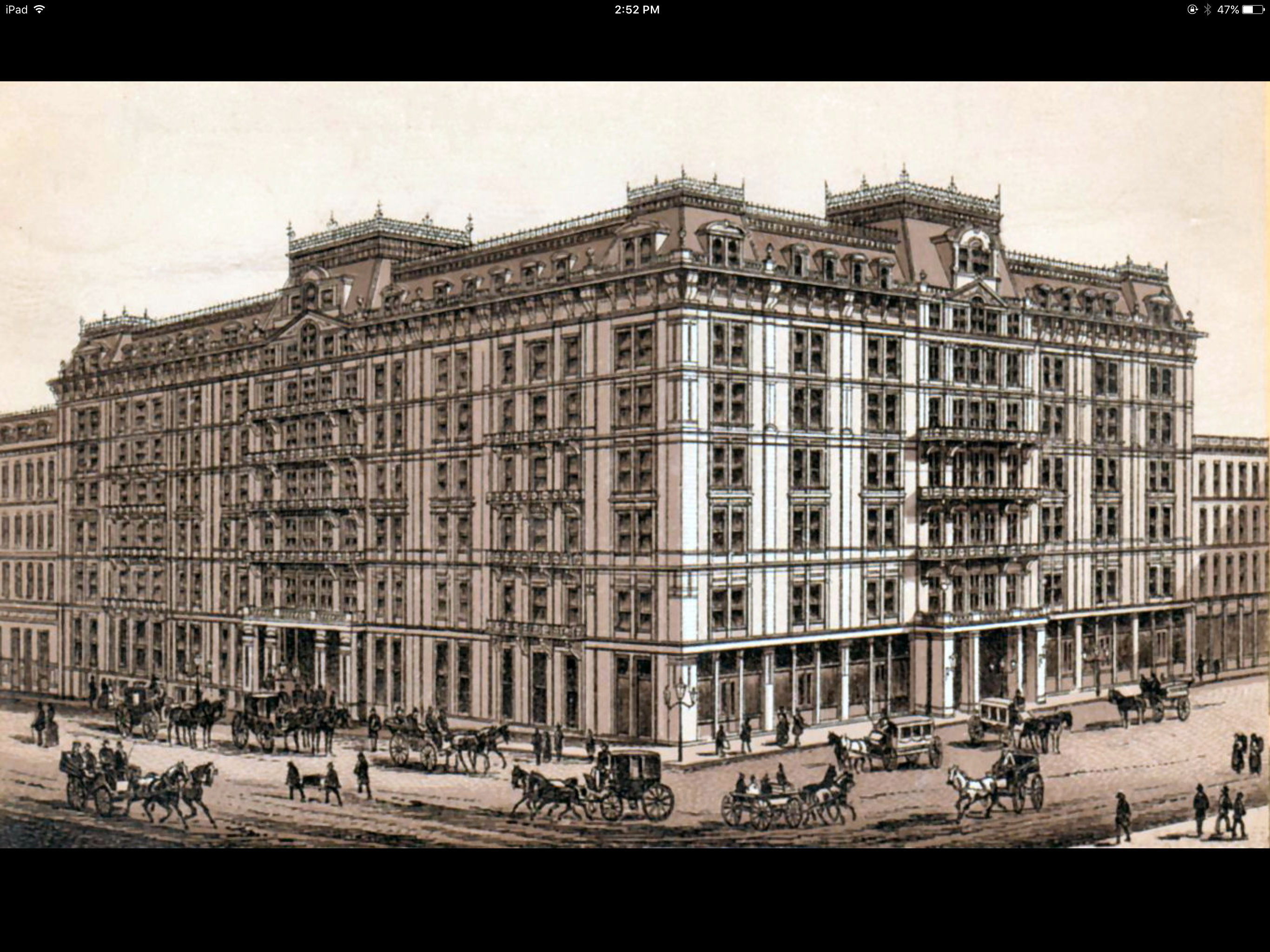
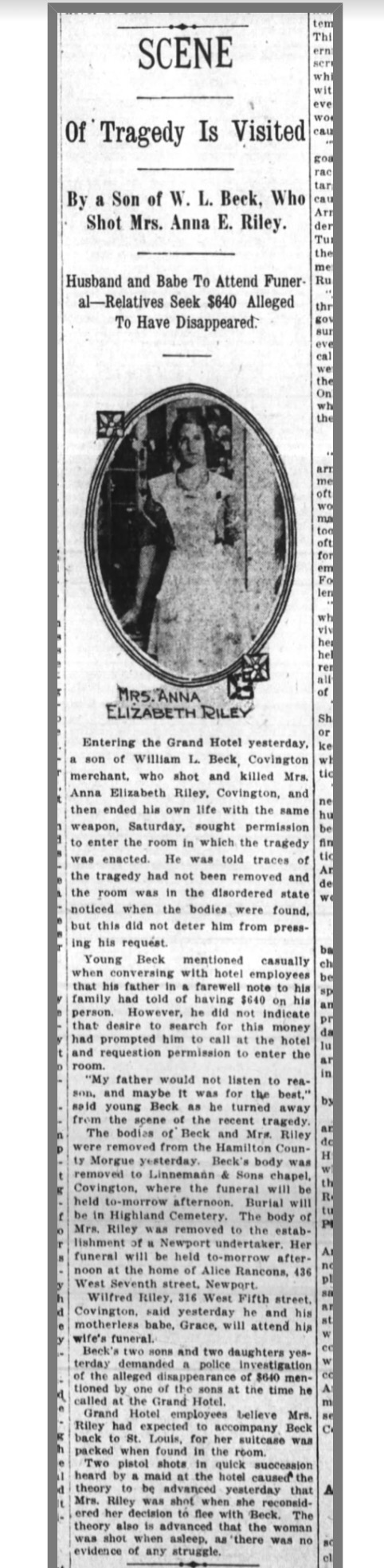
The scandal: my grandmother, Anna Nix Riley, was killed by an older man known to the family, William Beck, who had fallen in love with her. Quite possibly they had an affair. My grandparents lived in Covington, Kentucky, and Anna took the trolley to the Grand Hotel in Cincinnati to meet Mr. Beck where she told him that she would not leave her husband and go to St. Louis with him. She had her eight-month old infant, Grace with her.

Anna laid down on the bed with her baby girl and fell to sleep. A mother myself, I can only guess that she drifted off while coaxing her baby to sleep. Mr. Beck wrote a seven-page letter explaining how much he loved Anna and did not wish to go on living without her, shot her in the head while she slept, and then shot and killed himself.

While this would be headline news in any year, in 1918 it was a newspaper sensation that ran for several issues in the Cincinnati Enquirer and other local newspapers of the time. My grandmother became an anathema. She was never spoken of again and my father grew up knowing nothing about her. He learned early on that he could not ask about her; could never mention her or her name. I cannot imagine how that would damage a child’s self esteem since so much of our self image is a reflection of our parents.

Baby Grace? No one alive knows what happened to her. My father was raised by his father and paternal grandparents. Baby Grace disappeared. Another family must have taken her in but 100 years later, we do not know who that family was.

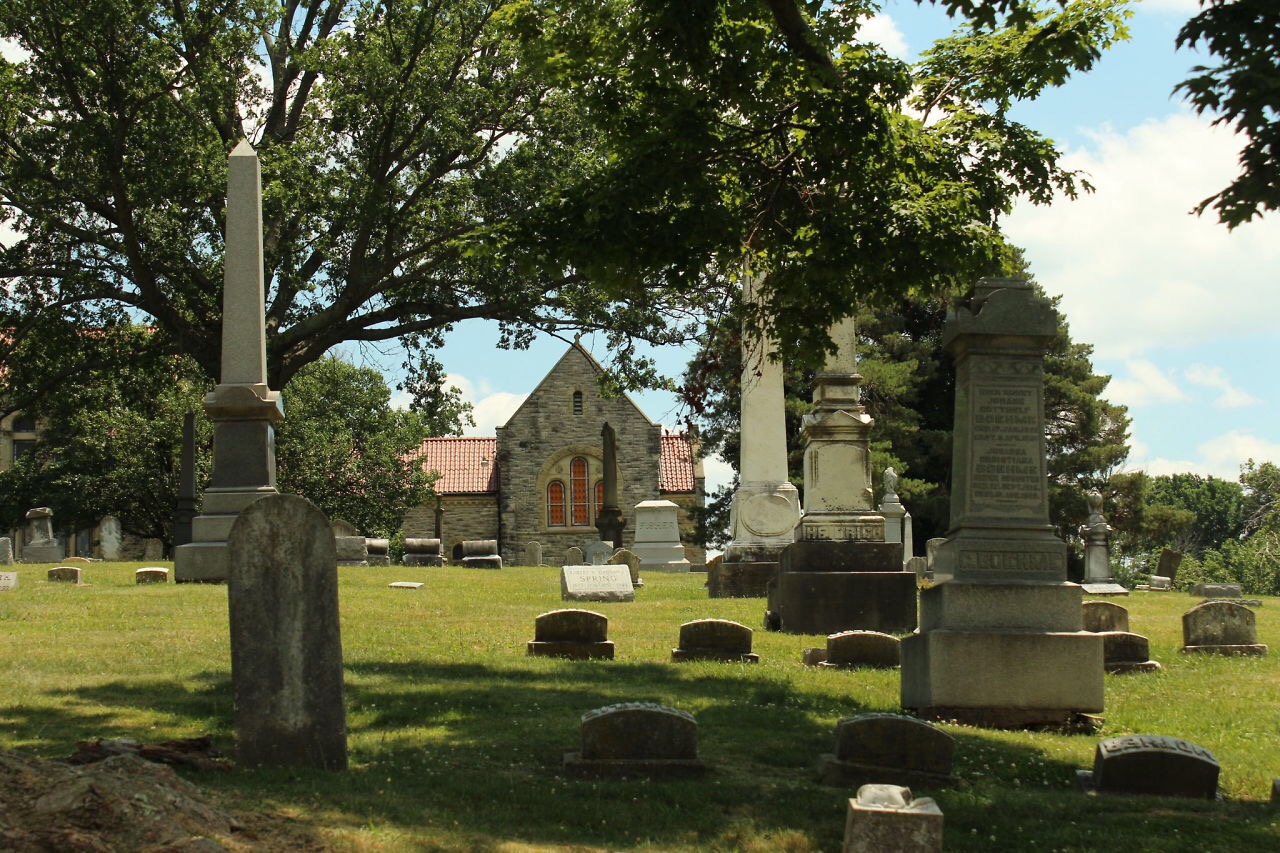
Anna Nix Riley was buried in Evergreen Cemetery south of Newport in an unmarked grave. No headstone marks the site, just a lot marker in section 42 lot 306 that is grown over and hidden by decades of shifting soil and grasses. Her grave has disappeared as did baby Grace. What I know of my grandmother I learned from census records, historical documents and newspaper clippings. It saddens me.

Evergreen Cemetery, South Gate, KY where Anna Nix Riley was buried in 1918

Preparing for My First Adventure

Bear in Fall-rev-5w-web

My sleep patterns are off. I am awake all night and sleep all day. It started while Karen was in the hospital and I remember talking to her about it. I attributed it to anxiety, and I think that is the major cause although there might be other reasons. What troubles me the most is when I cannot fall to sleep until seven o’clock in the morning even when I force myself to bed before two o’clock. I lie awake “buzzing,” I don’t know how else to describe it. What that means is that I accomplish very little during the hours when I am awake because I am simply too exhausted.

What I have accomplished so far: I cleaned my porch and put everything back that was displaced by painting three months ago. I sorted out and filled three large boxes with stuff to donate and pitched the equivalent amount of assorted “stuff” into the trash. I arranged to close out my IRA account and am waiting for those funds to be deposited in my checking account and ordered an alarm system to protect the house while I am away from home. Once the alarm system is installed, there are no more excuses for not taking to the road.

I worked a few hours on my manuscript and need to do more before I leave. I have so many paintings, not all of which are worth keeping and in the process of sorting through them I ran across one that I thought could be salvaged. Lightening the water and creating more depth to the foliage in my bear painting was another small accomplishment. So much to do and so little energy! I just wish I could get back to more sane sleep patterns. Hopefully, a road trip will help to that end.

Looking Back-Looking Forward

My mind has been a little strange lately. All kinds of memories come to me, sometimes in long streams like videos, and other times just snippets like photographs that describe the moment but leave out what happened just before or came right after. I know what has opened this stream of consciousness. I am at that age when my friends and contemporaries are dying off routinely. My Christmas card list grows shorter every year.

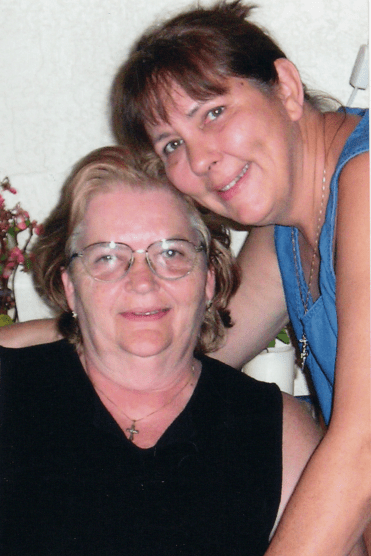
Karen-Dottie-2004Karen, my friend of over 30 years, died May 1, 2017. Another hole in the fabric of my life. I can’t explain our relationship. Once, I was closer to her than to any person alive. She lived with me for three to four year stretches at a time. She would be here and then move out without warning. Sometimes she had a good reason. She bought herself a townhouse in Tampa, but she could not bring herself to tell me until three weeks before she moved out. Another time she moved to Springfield, Pennsylvania to live with her sister but a few years later, asked if she could come back when that didn’t work out.

There were also periods of silence that could last years. When she did not speak to me it was never because I did something to Karen, but rather because of the guilt she felt for hurting me. A perfect example is the months before she died. I last saw Karen at Christmas when I stopped by to drop off a Christmas gift for her. I didn’t hear from her again until she was last hospitalized in April, two weeks before she died. She told me that she was embarrassed because she did not have a gift for me, and because she could not invite me to her home over the Christmas holidays. She lived with her oldest son and he resented me.

Losing Karen was a shock. I have been aware of my mortality for some years, but that really brought it home. How much longer do I have? Is the life I am living all there is? Do I have anything except broken relationships to mark my life? I am estranged from nearly everyone I loved. I cannot remember the last time someone touched me. Was it Karen when she kissed me goodbye?

That same night I resolved to change my circumstances. The volunteer organization to which I belong eats up 70 percent of my waking life and leaves me little time for anything else. For that reason, I resigned from all of my offices. Now, there is nothing to stop me from traveling cross country, repairing old relationships, making new friends and enjoying new experiences. I need to do this. I must do this or I will drown in self-pity and self-contempt.

Photo: Karen (seated) and me, 2004