LET’S HAVE THE RIGHT CONVERSATION

sex-harass

No one needs the avalanche of news reports about sexual harassment and sexual assault to know that it is very real and that it happens every day, everywhere. It happens in schools, in the workplace, in churches, in social situations, and sadly for many, even at home. Is there a single adult in the room who did not know that sexual misconduct is rampant?  The endless charges against public figures expose our hypocrisy and complicity.  We knew, but before now, we turned a blind eye. Let’s not have this conversation when another is more relevant and productive. We must define appropriate behavior for both men and women as well as what constitutes sexual assault.

Rape is easy to define.  NO means NO and any inability to say YES (such as not being of the age of consent, inebriation or a position of power of one person over another) means NO. Other forms of sexual misconduct may not be as clear. When does flirtation become sexual assault? Does all touch beyond a handshake require consent? Can there be implied consent between adults? What about a pat on the back or a hug between friends or coworkers?) Are the rules for men and women the same? What about teens? Thanks to mother nature, it does not require much to give a young man an erection.

Sexual harassment dictates that when ‘A’ is uncomfortable with the behavior of ‘B’ (behavior not deliberately aimed at ‘A’), ‘A’ has a responsibility first to voice their discomfort. Only when ‘B’ ignores ‘A’s’ objection does it rise to the level of a sexual harassment complaint requiring administrative action. We must define what constitutes sexual misconduct and do so very quickly before the lives of many good men are destroyed.

Why would I, a survivor of gross sexual assault and debilitating sexual harassment say this? Because sexual misconduct is real and must be dealt with dispassionately. We must do this if not to avoid, then to reduce the number of sexual misconduct allegation becoming weaponized.

Too many women falsely allege that their spouse committed sexual abuse in child custody cases, and thousands of more women seek temporary restraining orders based upon false allegations. The upshot is that fewer allegations of incest and physical abuse are believed, meaning fewer women and children receive the protections they need. In the same vein, unsupported allegations of sexual misconduct will diminish their validity. One cannot solve a problem not deemed valid.

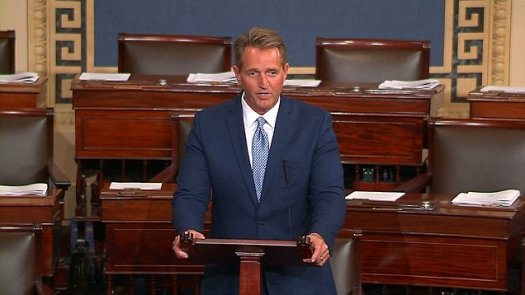
Senator Jeff Flake (R) Arizona Resigns

Jeff Flake (R) Arizona

It would appear that I am not alone in my sense of dread and despair over the direction our government is taking. Today, Jeff Flake, a conservative Republican senator from Arizona resigned. This is the resignation speech he delivered to the Senate with the president in attendance.  Like me, he wonders what kind of world we leave our children and grandchildren.

Mr. President, I rise today to address a matter that has been much on my mind, at a moment when it seems that our democracy is more defined by our discord and our dysfunction than it is by our values and our principles.  Let me begin by noting a somewhat obvious point that these offices that we hold are not ours to hold indefinitely.  We are not here simply to mark time. Sustained incumbency is certainly not the point of seeking office. And there are times when we must risk our careers in favor of our principles.

Now is such a time.

It must also be said that I rise today with no small measure of regret. Regret, because of the state of our disunion, regret because of the disrepair and destructiveness of our politics, regret because of the indecency of our discourse, regret because of the coarseness of our leadership, regret for the compromise of our moral authority, and by our – all of our – complicity in this alarming and dangerous state of affairs. It is time for our complicity and our accommodation of the unacceptable to end.

In this century, a new phrase has entered the language to describe the accommodation of a new and undesirable order – that phrase being “the new normal.” But we must never adjust to the present coarseness of our national dialogue – with the tone set at the top.

We must never regard as “normal” the regular and casual undermining of our democratic norms and ideals. We must never meekly accept the daily sundering of our country – the personal attacks, the threats against principles, freedoms, and institutions, the flagrant disregard for truth or decency, the reckless provocations, most often for the pettiest and most personal reasons, reasons having nothing whatsoever to do with the fortunes of the people that we have all been elected to serve.

None of these appalling features of our current politics should ever be regarded as normal. We must never allow ourselves to lapse into thinking that this is just the way things are now. If we simply become inured to this condition, thinking that this is just politics as usual, then heaven help us. Without fear of the consequences, and without consideration of the rules of what is politically safe or palatable, we must stop pretending that the degradation of our politics and the conduct of some in our executive branch are normal. They are not normal.

Reckless, outrageous, and undignified behavior has become excused and countenanced as “telling it like it is,” when it is actually just reckless, outrageous, and undignified.

And when such behavior emanates from the top of our government, it is something else: It is dangerous to a democracy. Such behavior does not project strength – because our strength comes from our values. It instead projects a corruption of the spirit, and weakness.

It is often said that children are watching. Well, they are. And what are we going to do about that?

When the next generation asks us, Why didn’t you do something? Why didn’t you speak up? — what are we going to say?

Mr. President, I rise today to say: Enough. We must dedicate ourselves to making sure that the anomalous never becomes normal. With respect and humility, I must say that we have fooled ourselves for long enough that a pivot to governing is right around the corner, a return to civility and stability right behind it. We know better than that. By now, we all know better than that.

Here, today, I stand to say that we would better serve the country and better fulfill our obligations under the constitution by adhering to our Article 1 “old normal” – Mr. Madison’s doctrine of the separation of powers. This genius innovation which affirms Madison’s status as a true visionary and for which Madison argued in Federalist 51 – held that the equal branches of our government would balance and counteract each other when necessary. “Ambition counteracts ambition,” he wrote.

But what happens if ambition fails to counteract ambition? What happens if stability fails to assert itself in the face of chaos and instability? If decency fails to call out indecency? Were the shoe on the other foot, would we Republicans meekly accept such behavior on display from dominant Democrats? Of course not, and we would be wrong if we did.

When we remain silent and fail to act when we know that that silence and inaction is the wrong thing to do – because of political considerations, because we might make enemies, because we might alienate the base, because we might provoke a primary challenge, because ad infinitum, ad nauseam – when we succumb to those considerations in spite of what should be greater considerations and imperatives in defense of the institutions of our liberty, then we dishonor our principles and forsake our obligations. Those things are far more important than politics.

Now, I am aware that more politically savvy people than I caution against such talk. I am aware that a segment of my party believes that anything short of complete and unquestioning loyalty to a president who belongs to my party is unacceptable and suspect.

If I have been critical, it not because I relish criticizing the behavior of the president of the United States.  If I have been critical, it is because I believe that it is my obligation to do so, as a matter of duty and conscience. The notion that one should stay silent as the norms and values that keep America strong are undermined and as the alliances and agreements that ensure the stability of the entire world are routinely threatened by the level of thought that goes into 140 characters – the notion that one should say and do nothing in the face of such mercurial behavior is ahistoric and, I believe, profoundly misguided.

A Republican president named Roosevelt had this to say about the president and a citizen’s relationship to the office:

“The President is merely the most important among a large number of public servants. He should be supported or opposed exactly to the degree which is warranted by his good conduct or bad conduct, his efficiency or inefficiency in rendering loyal, able, and disinterested service to the nation as a whole. Therefore, it is absolutely necessary that there should be full liberty to tell the truth about his acts, and this means that it is exactly as necessary to blame him when he does wrong as to praise him when he does right. Any other attitude in an American citizen is both base and servile.”  President Roosevelt continued. “To announce that there must be no criticism of the President, or that we are to stand by the President, right or wrong, is not only unpatriotic and servile, but is morally treasonable to the American public.”

Acting on conscience and principle is the manner in which we express our moral selves, and as such, loyalty to conscience and principle should supersede loyalty to any man or party. We can all be forgiven for failing in that measure from time to time. I certainly put myself at the top of the list of those who fall short in that regard. I am holier-than-none. But too often, we rush not to salvage principle but to forgive and excuse our failures so that we might accommodate them and go right on failing-until the accommodation itself becomes our principle.

In that way and over time, we can justify almost any behavior and sacrifice almost any principle. I’m afraid that is where we now find ourselves. When a leader correctly identifies real hurt and insecurity in our country and instead of addressing it goes looking for somebody to blame, there is perhaps nothing more devastating to a pluralistic society. Leadership knows that most often a good place to start in assigning blame is to first look somewhat closer to home. Leadership knows where the buck stops. Humility helps. Character counts. Leadership does not knowingly encourage or feed ugly and debased appetites in us.

Leadership lives by the American creed: E Pluribus Unum. From many, one. American leadership looks to the world, and just as Lincoln did, sees the family of man. Humanity is not a zero-sum game. When we have been at our most prosperous, we have also been at our most principled. And when we do well, the rest of the world also does well.

These articles of civic faith have been central to the American identity for as long as we have all been alive. They are our birthright and our obligation. We must guard them jealously, and pass them on for as long as the calendar has days. To betray them, or to be unserious in their defense is a betrayal of the fundamental obligations of American leadership.  And to behave as if they don’t matter is simply not who we are.

Now, the efficacy of American leadership around the globe has come into question. When the United States emerged from World War II we contributed about half of the world’s economic activity. 

It would have been easy to secure our dominance, keeping the countries that had been defeated or greatly weakened during the war in their place.  We didn’t do that.  It would have been easy to focus inward.  We resisted those impulses.  Instead, we financed reconstruction of shattered countries and created international organizations and institutions that have helped provide security and foster prosperity around the world for more than 70 years.

Now, it seems that we, the architects of this visionary rules-based world order that has brought so much freedom and prosperity, are the ones most eager to abandon it.

The implications of this abandonment are profound. And the beneficiaries of this rather radical departure in the American approach to the world are the ideological enemies of our values. Despotism loves a vacuum.  And our allies are now looking elsewhere for leadership. Why are they doing this? None of this is normal. And what do we as United States Senators have to say about it?

The principles that underlie our politics, the values of our founding, are too vital to our identity and to our survival to allow them to be compromised by the requirements of politics. Because politics can make us silent when we should speak, and silence can equal complicity.

I have children and grandchildren to answer to, and so, Mr. President, I will not be complicit.

I have decided that I will be better able to represent the people of Arizona and to better serve my country and my conscience by freeing myself from the political considerations that consume far too much bandwidth and would cause me to compromise far too many principles.

To that end, I am announcing today that my service in the Senate will conclude at the end of my term in early January 2019.

It is clear at this moment that a traditional conservative who believes in limited government and free markets, who is devoted to free trade, and who is pro-immigration, has a narrower and narrower path to nomination in the Republican party – the party that for so long has defined itself by belief in those things.  It is also clear to me for the moment we have given in or given up on those core principles in favor of the more viscerally satisfying anger and resentment.  To be clear, the anger and resentment that the people feel at the royal mess we have created are justified.  But anger and resentment are not a governing philosophy.

There is an undeniable potency to a populist appeal – but mischaracterizing or misunderstanding our problems and giving in to the impulse to scapegoat and belittle threatens to turn us into a fearful, backward-looking people. In the case of the Republican party, those things also threaten to turn us into a fearful, backward-looking minority party.

We were not made great as a country by indulging or even exalting our worst impulses, turning against ourselves, glorying in the things which divide us, and calling fake things true and true things fake. And we did not become the beacon of freedom in the darkest corners of the world by flouting our institutions and failing to understand just how hard-won and vulnerable they are.

This spell will eventually break. That is my belief. We will return to ourselves once more, and I say the sooner the better. Because to have a healthy government we must have healthy and functioning parties. We must respect each other again in an atmosphere of shared facts and shared values, comity and good faith. We must argue our positions fervently, and never be afraid to compromise. We must assume the best of our fellow man, and always look for the good. Until that day comes, we must be unafraid to stand up and speak out as if our country depends on it. Because it does.

I plan to spend the remaining fourteen months of my senate term doing just that.

Mr. President, the graveyard is full of indispensable men and women — none of us here is indispensable. Nor were even the great figures from history who toiled at these very desks in this very chamber to shape this country that we have inherited. What is indispensable are the values that they consecrated in Philadelphia and in this place, values which have endured and will endure for so long as men and women wish to remain free. What is indispensable is what we do here in defense of those values. A political career doesn’t mean much if we are complicit in undermining those values.

I thank my colleagues for indulging me here today, and will close by borrowing the words of President Lincoln, who knew more about healing enmity and preserving our founding values than any other American who has ever lived. His words from his first inaugural were a prayer in his time, and are no less so in ours:

“We are not enemies, but friends. We must not be enemies. Though passion may have strained, it must not break our bonds of affection. The mystic chords of memory will swell when again touched, as surely they will be, by the better angels of our nature.”

Thank you, Mr. President. I yield the floor. Ω

Hurricane Trump Razes a Nation.

Why do I write about evacuating for Hurricane Irma and never mention the devastation caused by Hurricane Maria? Why do I avoid writing about my day to day life and the current sociopolitical climate? It is ugly. I will first tackle the second question because it leads to the answer to my first question.

I will never forget my sense of disbelief and despair on November 8, 2016, when the electoral college elected Donald Trump (R) over Hillary Clinton (D).  How was it possible? Clinton won by more than three million of the popular vote. Donald Trump, an American billionaire, had never held any political office. He was rude, crude and held openly racist views and bragged about sexually assaulting women and getting away with it. Married three times, the Christian right hailed him as their champion because he opposed abortion and was a strong supporter of gun rights. Since his election, he has voiced his support for Russia and Vladimir Putin while insulting American heroes and attacking the free press on a daily basis.

Since his inauguration, we have moved from one scandal to the next and from one crisis to another. I feel like a reverberating bell.  When I have not yet stopped reverberating from the clang of something as racist as an immigration ban on Muslims, there comes another scandal, like the Environmental Protection Agency stripping away clean air and water regulations, and Trump’s numerous attempts to repeal the American Healthcare Act and scaling back Social Security and Medicare benefits. His administration is trying to privatize the American education system and laid bare the school lunch program and other programs to feed the poor.

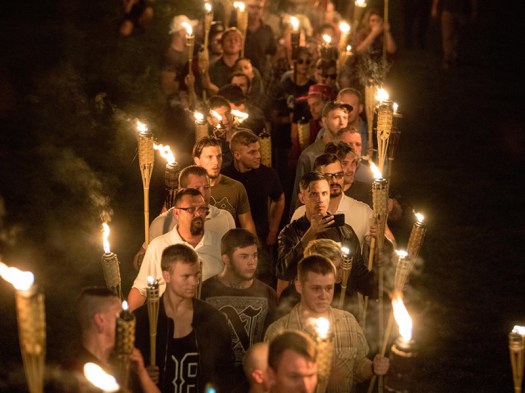
Charlottesville
Chanting, “White lives matter!” “You will not replace us!” and “Jews will not replace us!” several hundred white nationalists and white supremacists marched Friday as part of a Unite the Right rally at the University of Virginia that resulted in violence and three deaths the next day. (Photo by Evelyn Hockstein for The Washington Post)

Trump has attacked everything except the rights of multi-billion dollar corporations. He refused to endorse the Paris Climate Accord leaving us and Syria the only two nations that have not endorsed this world-wide effort to clean up the earth, and not ratified previously negotiated trade agreements because they are according to him, not fair to Americans. The most important issue is an investigation by the Justice Department and similar weak attempts by the Senate and House into possible collusion with Russia to throw the election. Russia hacked the Democratic National Committee and several states’ voting systems. We do not yet know the extent of the damage. I don’t even recognize my country anymore. Can this really be the U.S.A.?  Worse yet, Trump is recklessly courting a war with North Korea. That cannot end well for millions in both North and South Korea, Japan and China… and the United States.

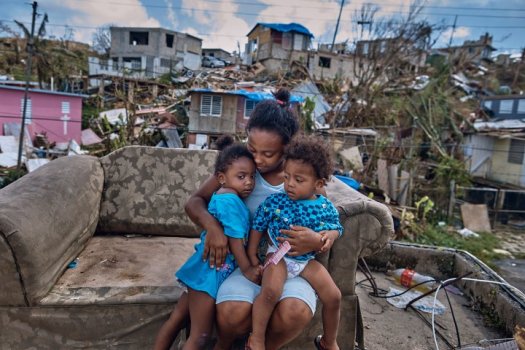
Enter Hurricane Maria. In August, Hurricane Harvey, a category two storm struck Houston. The damage was unimaginable.  A month later, Hurricane Irma struck Florida, and less than two weeks later, Hurricane Maria, a category five storm struck Puerto Rico and the U.S. Virgin Island and devastated those islands. It left little standing in its wake. More than a month later, less than 20% of Puerto Rico residents have electric or clean water.

puerto-rico-hurricane-maria-aftermath1
A family sits on a sodden couch were once stood their home. Photo by Andres Kudacki for TIME

How did Trump respond? Within three days he visited Houston and committed every possible resource to rebuild the area. He responded just as quickly to Florida after Irma, but while Maria was wiping out Puerto Rico and for the days after, Trump played golf at one of his resorts and tweeted incessantly against NFL players who kneeled rather than stood for the national anthem. Kneeling was in protest of the thousands of black men who die every year at the hands of law enforcement officers who are rarely held accountable. In too many instances, these black men were unarmed or shot in the back. Trump, however, is racist. It maddened him that these players dared to ‘disrespect’ the American flag.

Back to Puerto Rico. When Trump did finally tweet about Puerto Rico, he mentioned the territory’s massive debts and how bad their infrastructure was before the storm.  It took him three weeks to visit Puerto Rico to offer his support for its residents. It got uglier from there as he launched a personal attack against San Juan’s mayor. Puerto Rico is still a mess, and the newest scandal/crisis is four soldiers died in Niger earlier this month, and Trump and the Secretary of State insulted the wife of the only black soldier who died on that mission.

Trump is devastating the American sociopolitical landscape as surely as the hurricanes destroyed our soil. He is dividing the Republican Party and turning it into something not recognizable anymore. There are no more moderates. Republicans have moved to the extreme right, and any legislator who speaks or votes against them is labeled unpatriotic and un-American. When he campaigned, it was on the promise that he would change Washington forever. He is succeeding. I cannot help but wonder what will become of decent Republicans with a social conscience. I think Hurricane Trump has effectively annihilated them, at least for today. Will I live long enough to see the party regain its senses and recover from this? Ω

The Power of Kindness

Kindness is like a spider web
Gossamer threads belie their might.
One act of kindness pays forward until
A darkened world feels warm and bright.

Your touch on my shoulder lightens my heart
Your smile dries away my tears.
Your loving friendship has sustained me
Throughout the many years.

Your kind compassion does not end here
You have touched so many hearts.
Friends, family and strangers alike are
Connected through many parts.

Kindness is like a spider web
Shimmering threads dispel the night.
Each length of the web you lovingly weave
Thank you for bringing such light!

Escaping From Irma and Other Thoughts

This year’s hurricane season has been awful! Houston was slammed by Harvey in August and sustained severe flooding. Houston received up to 52 inches of rain in just a few days. A month later, Irma wound up the Caribbean and was forecasted to travel up the west coast of Florida. It was one of the biggest storms on record: over 3oo miles wide with wind speeds up to 175 miles per hour; and as I write this and less than two weeks later, Puerto Rico is presently under assail by another category five storm, hurricane Maria.

I planned to stay home during hurricane Irma and hope for the best, but a friend talked me into evacuating. Of course, all of my Facebook friends were urging me to do the same, so the choice between facing down a possible direct hit from a category five hurricane versus leaving along with 7 million other Floridians was an easy one. Evacuate.

The drive out of Florida was arduous. The highways were packed and until we reached Tallahassee, for many hundred mile stretches at a time, we could drive no faster than 25 miles per hour. By midnight we looked for a rest stop to sleep a bit and recover. At the first rest stop I had a wonderful experience; a Déjà vu of memories more than fifty years ago when things like Woodstock, love, and peace reigned. Dozens of people representing every age, gender, economic status and many races stood in groups sharing their experiences. A white man in designer clothing was talking to a Latino wearing faded jeans and a worn shirt. A young woman with several tired and cranky children allowed an old couple to share treats with their children and speak words of comfort to them. The storm was a great equalizer. Skin color, income, and education level did not seem to matter to people sharing a common threat. Unfortunately, George thought this rest stop was too bright and loud and believed that he would not be able to sleep, so we moved on to the next rest area.

One more thing. Florida state troopers (Florida Department of Law Enforcement) patrolled the rest stops, welcomed evacuees to stop and sleep, and directed cars to available parking spaces. They were kind and helpful. In addition to the standard restrooms, every rest stop had many portable toilets set up to reduce wait times.

Finding a hotel room was as difficult as the long drive. Millions of evacuees meant that there were no hotel or motel rooms available in Alabama or Mississippi. We ended up driving all the way to Metairie, Louisiana, a city about ten miles from New Orleans.

Two days later, we drove back home. Many gas stations had either no power or no gas, and the traffic was heavier than when we exited. I was fortunate. The storm veered east. Tampa was not hit by the eye of this storm but suffered only strong winds and heavy rains. I sustained just a few broken tree limbs. While we lost power in my neighborhood, it was back on by the time that I got home.

There are so many other things that I do not know how to talk about. I received a lot of love and support from family members, and I keep wondering why my son never called or texted me to make sure that I was ok. Before we evacuated, I asked to talk to my grandsons, but my son replied by text that he was too busy with meetings and soccer to arrange that call.

Yesterday was Tod’s birthday. He is my youngest son who died nine years ago. I miss him. Tod cared about me and often called me “just to talk” and to let me know what was going on in his life. He enjoyed talking to me and sometimes called for no reason other than to relay a story he knew I would enjoy. I know Tod would have called me before Irma because in 2004 when Florida had four hurricanes, my son came to stay with me to make sure that I was ok. Storms are traumatic events and many times these past weeks, I thought about him. Happy belated birthday, Tod! Fair winds and following seas.


Love is Not Enough

Love01I am a Baby Boomer, a child of the “Age of Aquarius;” the generation that rebelled against the rigidity and intolerance of our pre and World War II era parents. Our parent’s generation worldwide was responsible for more than 40 million deaths. The silver lining of that conflict was greater access to education and home buying by veterans of that war and of course, that “boom” in the birth rate that lent its name to our generation.

Reeling from the horror of that war, Baby Boomers protested our nation’s involvement in the war in Viet Nam and struggled for equality of the races and the sexes. We were called Hippies and Flower Children, and some of us “Women’s Libbers.” Most of us displayed a disdain for wealth and material possessions and championed the War on Poverty. We supported peace, equality, tolerance, and compassion under the banner love for all mankind. One would think that we would display more compassion and understanding as we assumed the mantle of political leadership. What went wrong?

We faulted our parents for concentrating too much wealth at the top of the social structure and leaving too little for the poor. Our generation then funneled more wealth to the top ten percent of the population and pushed millions more into the underclasses. We shrunk the middle class and chose to blame not the rich at the top, but the poor for siphoning off needed resources. The rich became our gods, the new American idols. With every step forward along our path to equality and tolerance, the ten percent dragged us three steps behind. Love was replaced with anger.

The right is angry because they believe that they are entitled to more. The top ten percent are angry because they are prevented from accumulating more wealth. The poor on the right are angry because they believe the lies told them by the ten percent. “It is the ones who do not look not like you or pray like you that keep prosperity from you.” They never noticed the immense fortunes that moved from their classes to the top ten percent and left less to be shared by everyone else.

The left is outraged at what they perceive as the callousness and ignorance of the right. Outrage is anger and indignation. We throw our facts at the right and are shocked when facts do not change feelings. We revert to marches and protests that served us well in the past and occasionally experience a small success. The left forgets that they are as responsible for the present social order as is the right. We worshiped at the altar of the rich until its painful tithing reminded us what we once stood for. The rich are at the altar by invitation. We helped to destroy the middle class which was once our power base.

Now all of us are angry. How did we get from there to here? I think we discovered that love is not enough.

My Colonial Riley Ancestors


Family trees bring history to life. Those who settled this great nation and fought Indians and who fought the American Revolution are not just people from a bygone era. They are my ancestors- my family.  I’ve traced my family tree on my father’s side back to Miles Reilly born 1614 in Ireland, who with his family and son, Hugh Aodh Riley, born in 1650 in Ireland, immigrated to this country and settled in Prince George’s County.

Most Irish immigrants were poor indentured servants and many were Catholics, but Miles was a Protestant landowner and merchant. Why did he choose to leave Ireland? Possibly because Ireland experienced repeated wars between Catholics and Protestants and ruling kings and clans. The new world may have held the promise of peace, prosperity, and adventure. Miles Reilly left Ireland and settled in Prince George County where his son, Hugh, married Margaret Ploumer. Hugh and Margaret gave birth to nine children, all of whom I can only presume were educated because they also became landowners and merchants. Their fifth son, Eliphaz, is my direct ancestor.

Eliphaz was born in 1689. He lived in Prince George’s County all his life. Eliphaz married Elizabeth Burkett in 1714 and had ten children. He is on record as purchasing “the Hop yard tract of land” (land situated between Friendship and the Potomac River). He is on record requesting a license for an ordinary or tavern in 1750 and is listed signing a petition for the erection of a new county from Prince George’s and Frederick’s, which would become known as Montgomery County. He was a member of the Rock Creek Episcopalian Church of England. In his will dated December 8, 1759, he left the Hop yard to the children of his sons James and Jeremiah. Other than these few records, there is very little known of Eliphaz.

What was Maryland like in those years? Prince George County is described as a flourishing settlement with as many as 2,500 residents, a bit more than half of which were indentured servants and slaves. Their lives were almost solely agrarian, and tobacco was the biggest cash crop necessitating a large, cheap work force (hence, the need for slaves and indentures). They did not consider themselves Americans. They thought of themselves as English colonists who swore fealty to King George and the English crown.

I am struggling to picture their farms and farm houses. I struggle to picture them working in the fields, washing clothes and making soap. Likely they did not have to do all of these things themselves. They owned slaves, and landowners were in a class of their own with the right to vote and make decisions for the community. Landowners were invested in being as genteel as possible and dressed their children fashionably, sent them to school and delighted in European art, music, and culture. Despite this, life was difficult. Medicine was not ‘modern,’ and Indians raided remote farms. Daily life could not have been that easy even for the more privileged. I also cannot imagine their reactions when their children swore Oaths of Allegiance to Maryland and fought for independence from England.

By the way, acknowledging their status as slave owners is not a statement of approval. That was their life. Eliphaz’ grandson, Rev. Gerard Riley, was an abolitionist and active in the Underground Railroad. Different times, different values.

Poems For My Sons

Son-poem

A Poem I wrote over a decade ago for my son, Michael:

The wide-eyed grin of my baby boy
Smiles back at me from pages worn.
A little boy with ball and mitt,
Next older, opening Christmas gifts.

The troubled adolescent frowns,
But other images I own…
A boy building sand castles upon the shore,
Riding bikes, and there are more….

A boy who chased through trees and moors,
A young man who a uniform wore.
Photographs of past loves and loss,
Beside his bride, content and grown.

Now separated by time and space,
Now thrust apart by memories torn,
I miss my son, flesh of my flesh,
I miss his smile and his embrace.

Still, in these pages that I turn
There yet remains the younger boy,
Who can recall the moments when,
He knew that he too loved me then.

One written for my son, Tod:phonecalls-from-heaven

Phone Calls From Heaven

I’m lonelier now that my son has moved to heaven.
He doesn’t write or send postcards from there.
I hear it is a lovely place, this heaven,
So say the folks who’ve never once been there.

They say it is a kinder, gentler place, this heaven.
They say there is no sorrow or travails,
They say when in my dreams I see him,
It is he calling me from there.

DJR Oct 2015


Tod with One “d”

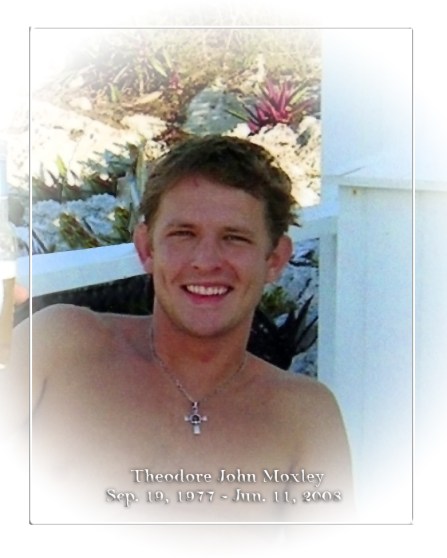
Tod portrait
Portrait of Tod Moxley

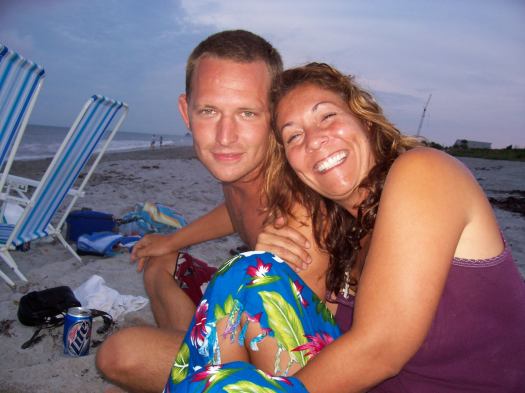
His name was Theodore John Moxley born Sept. 19, 1977, and he was my youngest son. Tod was a beautiful boy with dark blond hair, green eyes, and dimples. His personality can only be described as effervescent, and everyone loved him except his teachers at school. Tod simply could not be contained or controlled. That, unfortunately, is a trait shared by many highly intelligent people.

There is nothing Tod wanted more than the love and approval of the most significant men in his life- his father and his older brother, but he was never able to find either. His older brother alleges that he made peace with Tod in the years before his death, but I know that is not how Tod felt. We last talked about his older brother a month before he died.

When Tod gave his heart, it was completely and without reservation. He loved me and adored his wife. He loved people- all people regardless of race, religion or economic status. His friends included people from all walks of life. More than anything, he was a comic who made others laugh and a listener who made others feel important. In short, people loved being with and around him. He was incredibly beautiful in body and spirit.

My oldest son was envious of Tod and my relationship with him and called him “my golden boy.” Michael did not understand that it is easier to express love to someone who accepts and returns my affections. I love Michael too, but it was and continues to be hard to cut through the layers of resentment.

Tod was deeply troubled. His father rejected him from birth to the age of 15 and then made his love and approval conditional. That wounded him deeply. Tod’s response to conflict was to escape through drugs. Before he turned 18, my reaction was to place him in rehabilitation centers whenever I knew he was using, but little did I know that the close friends I trusted to help him outside of treatment were the ones supplying him with drugs. No, I do not see Tod through rose-colored glasses nor do I blame others for his failures. His missteps in life were as big as his personality.

What surprises me is how people loved him when he was alive and continue to love him today even though he is gone.

Tod and Annie from Jennifer
Tod and his wife, Annie, 2007.


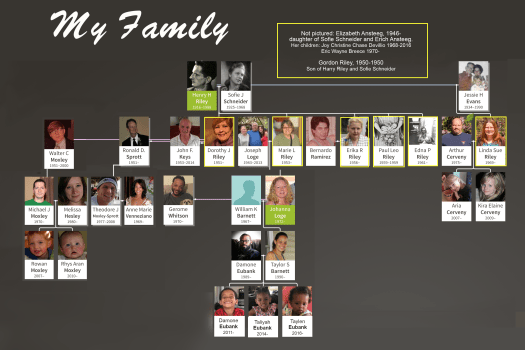
Who’s Who in My Family

Family tree 2017-unframed-yellow-plus-text

As I write about myself and members of my family, it might be to my reader’s advantage to post my family tree to serve as a ‘cast of characters.’ Refer back to this as necessary. I have not included my grandparents and aunts and uncles; just my immediate family. My siblings have yellow borders added and I included their children and grandchildren.