A Different Path to Education

USF

I earned a Masters in Social Work from the University of South Florida in 1980. It was a dream come true for a girl from the projects of Newport, Kentucky. How this came about is this story.

I grew up poor, and after the age of 12, was a ward of the state and spent my teenage years in foster homes and institutions. That should be singular. I was in one institution, Our Lady of the Highlands in Fort Thomas, Kentucky, which preceded two failed foster care placements.

The second foster family sent me to live with my father, the man who had sexually abused me as a little girl. Yes, they knew what he had done, but they said he was a Christian now and that God had forgiven him. Although I knew he would never again molest me, it was still stressful. Every day I faced the reminder of what had been, and I held my breath every time he walked past my bedroom door at night.

My oldest sister also lived with him as did my younger sister. My oldest sister had always blamed me for the breakup of our family because I reported the abuse. She was four or five months pregnant and said that she could not work to help support us. My father held a minimum wage job, which in 1968 was $1.60 an hour. She and my father encouraged me to get a job to help with expenses and so that Liz could buy baby clothes and other things for her coming child. I did as expected of me and dropped out of school.

Living with my family did not work out for me, and since I was employed full time, a family court judge gave me custody of myself. After a few months, I moved in with a friend in Pennsylvania and tried going back to school, but again I dropped out. Finally, in 1969 I took the G.E.D. examination and passed.  A high school equivalency was better than no diploma at all.

I will skip past years that included getting married, having a baby, and other life-altering events and jump to my years in the U.S. Army. There, I learned about the DANTE*[1] tests and CLEP*[2] tests and took advantage of them to earn over 90 credits. I also attended classes at one of Park University campuses at Fort Bliss, Texas. When I left the military, I had over 120 credits but no degree.  That meant taking additional courses at St. Joseph’s College in Philadelphia and at West Chester State College in Pennsylvania. Those credits were transferred back to Park University, which awarded me a bachelor’s degree in Social Psychology in 1980.

By then I had two children to support and no financial or any other type of assistance from my sons’ fathers. At least the degree helped me get a better paying job. I got married again, and a few years later, we moved to Florida.

I had no idea what a social worker was until I met one in a nursing home. She told me a little about the field, and I realized that this is what I wanted to do for the rest of my working life. She told me that the University of South Florida had a social work program. It took me another year to apply because I had never taken the SAT. That terrified me. How could I pass the SAT when I never attended regular college courses? I bought books and studied at home for a year, then completed the application for the test and sent in the fee.

The day of the test, I was so anxious that I had panic attacks and could not focus. A voice in my head told me that taking the test was an act of futility. I don’t know how I got through it. When my scores arrived in the mail, I had mixed feelings. I was disappointed that I had scored so low but thrilled that I scored high enough to meet the university’s admission requirements. (Not sure now, but I think I scored 1150. Not impressive.)

I submitted my application to the program just before the deadline for the upcoming school year. I knew that less than 20% of all applicants were accepted and that it would take months after the interview to learn if I had been approved. By the day of the interview, I had so little real hope that I faced my interviewer with the attitude that I had nothing to lose. I must add one other thing. Before the interview, I prayed a lot. I told God that I needed his help but that I had trouble discerning between his will and mine, and that if it was his will that I should be a social worker, that he had to give me a sign, and nothing subtle either. It had to be significant, like handwriting on the wall.

I got my handwriting on the wall. I don’t remember the interview, but I remember how it ended. At the conclusion, my interviewer stuck out his hand to shake mine. Instead of a polite “goodbye” he said, “welcome to the University of South Florida Graduate School of Social Work.” I could not believe what I had heard and asked him to verify that I was in.

I completed the Masters in Social Work with a 3.77 GPA. I could not manage better than a ‘B’ in statistics, and one of my professors downgraded me a full grade, from an ‘A’ to a ‘B’ for missing too many classes. I did not point out to him that I attended school full time, worked 40 hours a week at night, and another 20 hours a week for my internship in addition to having a family. I was too proud. It only mattered that I completed the program and earned my degree. Even with a less than 4.0 GPA, I was in the top 10% of my class. My bachelor’s degree was often scoffed at because I tested out of more courses than I attended, but no one could take this accomplishment away from me. Ω


[1] DSST (formerly DANTES Subject Standardized Tests) are credit-by-examination tests originated by the United States Department of Defense’s Defense Activity for Non-Traditional Education Support (DANTES) program.

[2] The College Board’s College-Level Examination Program (CLEP)
 

The Yellow Peril

Transcontinental Rail Road
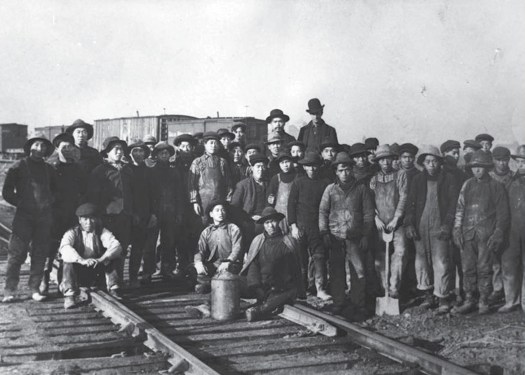
Chinese work group for the Great Northern Railway, c. 1909. (Photo courtesy of Royal British Columbia Museum)

My painting, “Coming to America,” depicts the worst prejudice and discrimination policies and practices in our nation’s history of immigration and expansion. Today, the nation’s focus is on brown people, but a century ago, our nation’s ire was directed at those of oriental descent.

THE YELLOW PERIL

Historians estimate that at any one time as many as 10,000 to 15,000 Chinese worked to construct the transcontinental rail road. Because records were poorly kept, that figure could be as high as 20,000.

“While industrial employers were eager to get this new and cheap labor, the ordinary white public was stirred to anger by the presence of this “yellow peril”. Despite the provisions for equal treatment of Chinese immigrants in the 1868 Burlingame Treaty, political and labor organizations rallied against the immigration of what they regarded as a degraded race and “cheap Chinese labor”.

Newspapers condemned the policies of employers, and even church leaders denounced the entrance of these aliens into what was regarded as a land for whites only. So hostile was the opposition that in 1882 the United States Congress eventually passed the Chinese Exclusion Act, which prohibited immigration from China for the next ten years. This law was then extended by the Geary Act in 1892. The Chinese Exclusion Act was the only U.S. law ever to prevent immigration and naturalization on the basis of race.

These laws not only prevented new immigration but also brought additional suffering as they prevented the reunion of the families of thousands of Chinese men already living in the United States (that is, men who had left China without their wives and children); anti-miscegenation laws in many Western states prohibited the Chinese men from marrying white women.

In 1924 the law barred further entries of Chinese; those already in the United States had been ineligible for citizenship since the previous year. Also, by 1924, all Asian immigrants (except people from the Philippines, which had been annexed by the United States in 1898) were utterly excluded by law, denied citizenship and naturalization, and prevented from owning land. In many Western states, Asian immigrants are even prevented from marrying Caucasians.” –Wikipedia, History of Chinese Americans

http://libraries.ucsd.edu/blogs/blog/geisel-library-exhibit-sheds-light-on-chinese-workers-who-built-transcontinental-railway/

Complicated Families

32904617_2118638778149747_3200258966374318080_o
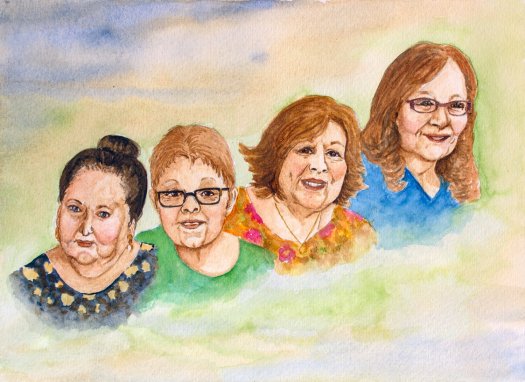
Sofie’s Girls

My family relationships are complicated, but then, that may be true for most of us. I have five sisters and am close to only one, the youngest. I get along OK with the next youngest, but her life is problematic, and I may not be her most sympathetic listener. She struggles with an addiction to pain pills, the same affliction that robbed my son of his life. My efforts to encourage her to seek treatment has succeeded in making her avoid talking to me.

My mother, Sofie, had five daughters, the youngest of which is institutionalized for severe brain damage. My mother had Pleurisy while pregnant and in 1960, doctors did not fully recognize the threat of x-rays to a developing fetus. The sister to whom I refer as my youngest, Linda, has a different mother.

With my other two sisters, Marie and Liz, my relationships are often either strained or estranged. If they had to list which of their sisters they got along with the best, I would place at the bottom of their list. Strangely enough, none of them (Sofie’s daughters) have a relationship with Linda, and I cannot explain why. Her name would not appear on their roll of siblings.

Members of my family treat me like a pariah. That too, I do not understand. I have never done any of the truly hateful and hurtful things to them that they have done to me. My oldest son has not called me in years to say hello while his wife never speaks to me at all. I took this up with my therapist more than once because it hurts me deeply, but I don’t like where it always ends up. Could my sisters honestly be envious of me? My son, Tod, thought so. Tod always said that I was a tough act to follow. I accomplished much in my life and did it despite substantial childhood setbacks. I survived sexual abuse by my father, an alcoholic mother who rejected me, foster homes, and institutions. Yes, I have significant failings. I am damaged. I suffer from Post-Traumatic Stress Disorder, and I do not know how to build and maintain healthy relationships. My daughter-in-law calls this “just a poor excuse” for not being a better mother, but her opinions about my mothering skills came from my son, Michael. He envied and resented his younger brother and called him my “golden boy.”

Without the love and support of my family, I seek validation of my worth as a human being in the things that I accomplish. I earned a Master in Social Work when none of Sofie’s other daughters graduated high school. My sisters resented me for that. For decades, I had to listen to the incessant refrain that I think that I am better than them, and now, I am called one of the “educated elitists.” Sigh!

Thanks to my education, I held better-paying jobs and lived in better neighborhoods. My worst nightmare was that my sons would end up living the life of poverty that I worked so hard to escape. Those fears were unfounded as both of my sons did well. I own two houses, or should I say, I carry mortgages on two! I am in debt, but I have savings as well. Having more money would be a nice thing but my income exceeds my expenses, and I live comfortably. I mention my finances first because this society measures success by our means.

My art has brought me other measures of success. While I am self-taught and most of my work is mediocre at best, I have managed to get a few paintings accepted into museum collections and earned several national public service awards. As a member of a national military affiliated volunteer organization, I received numerous honors as editor and graphic design artist. I need this validation. You see, without the love and support of family, I constantly doubt my worth. I would gladly exchange all of my awards for a family that loves and cherishes me.

My son, Tod loved me dearly, but he is no longer living. I am grateful beyond words to my sister, Linda and her family because they do love and appreciate me. I love them dearly too. For obvious reasons, I am closer to Linda’s daughters than I am to my grandsons. I wish that were not true, but it is. I take comfort in knowing that no matter how estranged Michael is from me, he is a great father to his sons. I wish that I did not feel so alone and isolated, but life goes on. Ω

For the Record: Yes, I am a Democrat

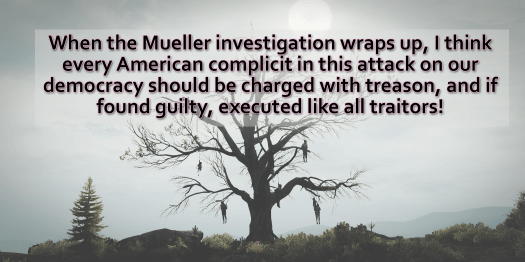
Traitors

Yes, I have always registered as a Democrat. I was last politically active during the late 1960-1970s when I protested: 1.) for racial equality 2.) for equal rights for women and 3.) against the war in Viet Nam. My politics did not blind me then any more than they do now. I am, after all, a Viet Nam era veteran and given my gender, know for sure that the Army did not draft me.

Apart from Richard Nixon and Watergate, before Trump, I stood behind every U.S. president regardless of their political party. I was honored to briefly meet President Gerald Ford (R) at Fort Bliss, Texas. My thinking was that while you might prefer the other candidate while they are on the campaign trail, once elected; they are our President and Commander-in-Chief. You will not find any posts denigrating former presidents on my Facebook timeline.

Trump is a different story altogether. He is arrogant, corrupt, a wrecking ball on the international socio-political landscape, a racist and a perpetual liar. His administration’s policies harm American citizens, especially our children.  Stripping the EPA of clean air and clean water regulations has disastrous consequences. (FYI: A Republican president started the EPA!) Cutting back on housing and food programs that are safety nets for the poor has dire consequences, as is taking funds from public education to fund private schools. Attacking the free press at every opportunity weakens our democracy through the erosion of credibility in legitimate news sources. The Washington Post has it right: “Democracy Dies in Darkness!” Trump’s trade wars are already showing harmful consequences to American farmers and companies. All of this without mentioning Trump’s racist and inhumane immigration policies.

Most egregious are Trump’s attacks against our Justice Department and the intelligence community, and his endless praise of Putin and Russia. The state of California’s economy is more substantial than Russia’s, so he cannot justify his actions by citing possible trade benefits to our country.

Do I despise Trump? Yes. Does my hatred of him color my opinion? Possibly, but it does not change the provable facts of the harms he is doing to the American people. Republicans respond with, “But his policies are working. Look at how great the stock market is doing!”  The wealthiest 10% of Americans own 84% of the market, so how does that benefit the average citizen?

All of that said (and I could say more), Trump is the first American president that I am entirely unable to support. If I cannot stand behind a single (Republican) president in my lifetime, does that mean being a “die-hard” Democrat makes me biased? I think not. I think it makes me a realist. Trump is a national and international disaster. I hope I live long enough to see history bear this out. Ω

https://www.reuters.com/article/us-usa-russia-summit/shock-as-trump-backs-putin-on-election-meddling-at-summit-idUSKBN1K601D


Rest in Peace, Anna.

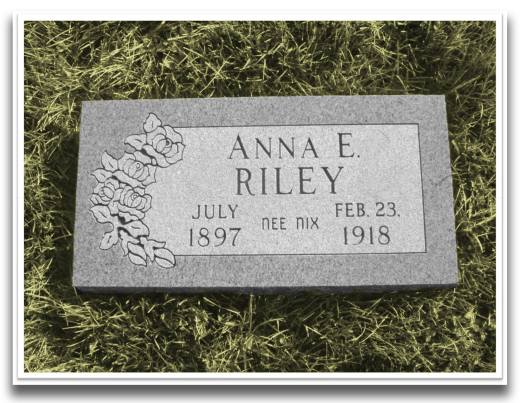
One-hundred years after the death of Anna E. Riley (nee Nix) and I finally have the closure denied to my father. Anna at long last has a tombstone, and I finally know what happened to her baby daughter, Grace E. Riley.

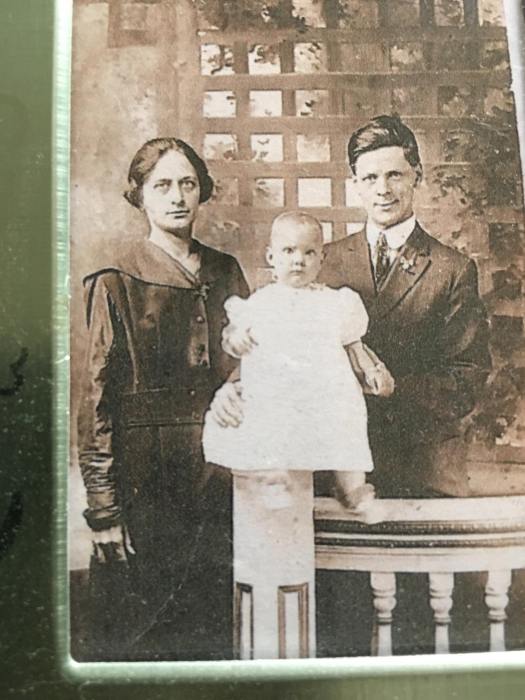
My father never knew more than myths and rumors about his mother. He could not talk about her to his family and from childhood built a myth around the little information that he had.  He knew that she was murdered by a lover who then killed himself. That much was accurate, but in my father’s myth, his mother was a Cherokee princess killed by a brave to whom she had been promised in marriage after she married my grandfather instead.

Anna was not Cherokee. She was of Irish descent, and then there is the ‘princess’ part. How is it that all white people of his generation who had Indian heritage insisted that his native American ancestor was a chief or a princess? At any rate, nineteen-year-old Anna was killed by a man much her senior who was enamored of her. She may or may not have committed adultery with him. She met him at the Grand Hotel in Cincinnati in February 1918 and told him that she would not leave behind her family to be with him. Overwhelmed with grief, he killed her, wrote a seven-page suicide letter explaining all of this, then killed himself. In the hotel room with them was Anna’s eight-month-old daughter, Grace Riley.

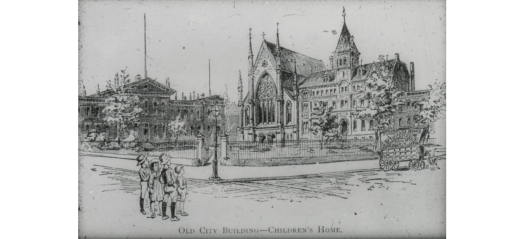
After Anna’s death, my grandfather, Wilford, and his three-year-old son, Henry (my father), moved in with Wilford’s parents. Baby Grace was immediately placed in one of several children’s homes in Cincinnati. After that, she disappeared. No trace of Grace appeared in any of my genealogy searches. I never knew what happened to her.  I always mourned her. How could her family care so little about her?  Neither Anna nor Wilford’s parents were willing (or able?) to take her in. What kind of people voluntarily relinquished their child, their grandchild?

Childrens-Home-Cincinnati

One hundred years later, I finally learned what happened to Grace. She was adopted by a couple that according to the account of one of her daughters, loved, even ‘doted’ on her. (Out of respect to her family’s right to privacy, I will not use their surnames.) Grace was renamed Kalya. She had a happy childhood, grew up, married and had five children of her own.  I am so happy to know that she was dearly loved by her parents and her children and I no longer pity her. Through adoption, she escaped the lies and the secrets that shaped my father who grew up feeling a deep sense of shame and inadequacy.

36438155_2338987152783817_6809375669454110720_n

While some of the shame was of his own making, I do not doubt that my father’s family played a role in his sense of inadequacy. Henry became Harry, and he left his family at the age of sixteen. He assumed Grace Riley’s birthdate which made him old enough to join the Army without parental consent. That is why he had two birthdates in his military records. His correct date of birth was not a part of his military records until he had to receive a top-secret security clearance from the Army for his role in the Nurnberg trials. My father divorced himself from his family so completely that he told me that he had no living relatives, no aunts, cousins or uncles. That too was a lie. After my father died, I learned that his aunts lived just a few blocks from us when we lived in Newport, Kentucky 1961-1962.

Grace, a/k/a Kalya escaped whatever drove Harry’s demons. I am happy for her and her children. They grew up feeling loved and cherished. They likely did not experience physical or sexual abuse or have their family torn apart by alcoholism. I inherited enough of my father’s shame that I don’t want them to know what it was like to grow up in Harry’s household. His inadequacies colored all of his children’s lives. It is enough for me to know that Grace escaped that family history and experienced something better. Bless her and her descendants!

The final part, and that which with I started this. Anna Riley was buried without a tombstone or anything to mark her life or her passing. Her affair made her an anathema to my father’s family, and my father never knew where his mother was buried. It took some searching for me to learn where. I tried to visit her grave last year, but there was no stone, and even the plot marker was deeply buried beneath the soil and grass. This year, I bought her a headstone. Anna deserves this much. Through her son and her daughter, she is the ancestor of two completely different families tied together only through her DNA. I cannot despise my grandmother for her possible infidelities. By the time that she died, she had lost two children and knew nothing except poverty and want. What nineteen-year-old does not wish for more? In the end, she chose her family and died for that decision. Rest in peace, Anna. Your life was not in vain.

36528631_2183199061693718_1850437769868869632_o


I Miss You, Son.

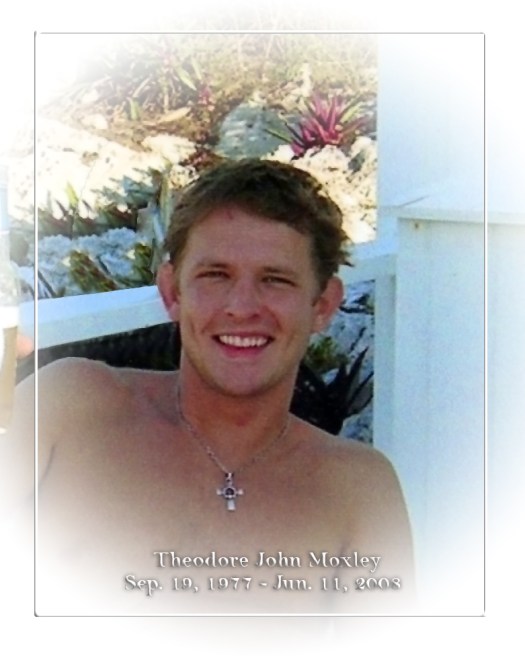
Tod portrait
Portrait of Tod Moxley

You left too soon. I will miss you always. You did not just rip a hole in my heart. You changed the landscape of my life like the eruption of a volcano that alters the land forever. And yes, it burns just as much.

The part of me that understands you dying is human. You were always in pain, and no one knew. They saw the charismatic young man with the attractive dimpled smile. They laughed at the jokes of a man who coped with life’s tragedies with humor. They admired the person who lived on the edge whether it was surfing on the ocean or defying social mores through the company you kept. Your friends were gay, black and white, male and female, rich and poor, long before society accepted people who were different. You drew no class distinctions, and in many ways, you were a true Renaissance Man. You were so much fun that others sought out your company and loved you, and your only distractors were those who envied you or expected someone with so many gifts to accomplish so much more. It was not enough that you simply wanted to enjoy your life and the people in it. Unfortunately, your detractors were those whom you most loved; those whose approval you most needed.

The part of me that does not understand you taking your own life is your mother. I loved you so deeply and needed you in my life. I needed your love. I needed your laughter. I needed those many times when you took a walk along the beach and called me for no reason other than to tell me that you loved me. I needed the long talks we had about everything; about nothing in particular. I regret that despite the many times that I told you that I loved you, you feared that you were a disappointment to me. You were not successful like your brother. You gave me no grandchildren. I think that last hurt you most of all. Yes, it was a disappointment, but I took it in stride. You were living the life you chose; the one that made you happy.

How did your death change the landscape of my life? It impacted nearly every relationship with my friends and family members. Many blamed me. Had I been a good mother you could not have committed suicide.  It mattered not that you were thirty years old, married and living miles away. I don’t know why I keep the letters from family and friends who cruelly spelled out why your death was my fault; that I did not love you enough or cared too little. They shut me out of their lives when I most needed the words from those who loved you to sustain me.

One of the unintended consequences of your death was the estrangement from your brother. His wife disdains me, and he has not called me once in many years to simply say, “Hello Mom.” They call you my “Golden Boy.” They tell me that I was a terrible mother who deserves no respect or affection from them. While you were alive, they were not like this. We visited. We exchanged warm phone calls. That is how the volcano of your loss separated me from him as well. Not surprising. Traumatic events tear apart many families. I am left with mountains of smoking lava separating me from those whom I most love and need.

June 11, 2018, marks ten years since you were gone. I miss you, son! I miss your love and your laughter. I miss you and will love you always.

I Weep For America

homelessnessPolitics has become an important part of my everyday life. I think that it is more than simply a function of age. I truly fear and despise Trump, his administration and the current political scene wherein Republicans/conservatives hold all three branches of government and refuse to reign in corruption. I believe that Trump may be more corrupt than Warren G. Harding whose policies were the precursor to the Great Depression.

Many of the regulations to protect our air and water have been wiped off the books and corporations are no longer obligated to pay to clean up when they pollute our water. We have abandoned the Paris Climate accord and now produce more waste than any other nation on earth.

Oh, the stock market is doing great, but 10% of Americans own 90% of the market so that is no help to the average citizen. Poverty is worsening. Over half a million people are homeless and this administration is pulling all of the safety nets out from under the poor. *

The cost of a college education has skyrocketed and programs that help students achieve a college education have been slashed. Without an education, there is no upward social mobility. I sincerely worry for my grandchildren. The middle class is shrinking while the number of poor increase, and many of our policies are cruel and inhumane- like separating the children of illegal immigrants from their parents when they cross our borders.

The cost of health care is shameful, and millions of Americans cannot afford health insurance and go without medical care. This is making America great? What is wrong with people that they do not see the destruction we are wreaking?

I weep for the country I love.


*Note: By some estimates, nearly four million people are homeless, but this figure includes those temporarily homeless due to evictions,  etc.

Government as Business

government

Business is the activity of making one’s living or making money by producing or buying and selling goods or services. Simply put, it is any activity or enterprise entered into for profit.

Government is authoritative direction or control and the complex of political institutions, laws and customs through which the function of governing is carried out. There is more within the Miriam-Webster definition similar in meaning, none of which end in “entered into for profit.”

Our government is not a business and was never meant to profit. In fact, the Preamble to the Constitution reads, “We the People of the United States, in order to… establish Justice, insure domestic Tranquility, provide for the common defense, promote the general Welfare, and secure the Blessings of Liberty to ourselves and our Posterity….”

At Gettysburg, Lincoln redefined the Civil War as a struggle not just for the Union, but also for the principle of human equality with his words, “…that this nation, under God, shall have a new birth of freedom — and that government of the people, by the people, for the people, shall not perish from the earth.”  Government should promote the general welfare of all persons equally, and promoting the general welfare comes at a cost.

Our social and economic policies remained a backdrop of  government and did not come to the forefront until Warren G. Harding. Harding promoted pro-business and anti-immigration policies, and enacted deep tax cuts for big business and the wealthy. (Sound familiar?) When Harding died in office, Calvin Coolidge inherited his scandal-ridden office during a period of pronounced materialism and excess. Coolidge succeeded in ridding the administration of corruption, but his economic policies did little to boost the economy or alleviate the suffering of the average citizens. The tax increase that he introduced in 1929 was too late to avert the crash of the stock market, which at the start of Herbert Hoover’s administration, culminated in the Great Depression .

Hoover’s nationalistic policies only worsened the Great Depression. He was unable to lessen the severity and suffering of millions Americans. That took Franklin D. Roosevelt’s New Deal spelled out by the three basic principles of relief, recovery and reform through programs designed to create jobs and most importantly, renew hope. Some of these programs included the Works Progress Administration, the Social Security Administration, and aid to farmers and migrant workers.

While Roosevelt’s programs were successful, poverty continued to impact large swaths of our citizens and slowed the growth of our national economy. The greatest and most far-reaching achievements in improving the lives of American citizens and boosting the economy came thirty years later with the introduction of Lyndon B. Johnson’s “War on Poverty,” seen as a continuation of Roosevelt’s New Deal. The legacy of the War on Poverty policy initiative continues to exist through such federal programs as Head Start, Volunteers in Service to America (VISTA), TRiO (eight education programs administered through the Department of Education), and Job Corps. Other programs include Medicaid and Medicare.

While critics pointed at the growing number social welfare policies and safety net programs and labelled America a “welfare state,” what could not be denied was the overall improvement in the quality of life for millions of Americans and the improvements in the national economy as measured by the growth domestic product (GDP).  Over the years, social and political events created fluctuations in the GDP growth rate but placing the welfare of citizens first has always worked best for our people, our economy and our nation.

The current economic policies under Donald Trump echo Harding’s years in office. Once again, we witness pro-business and anti-immigration policies, and deep tax cuts for big business and the wealthy. Other similarities to Harding’s administration are the evidences of materialism, excess and the extreme corruption of our politicians. The deficits are made up eliminating some of the social welfare policies created to protect the poorest and most vulnerable Americans, and through deep cuts into other programs that serve as a safety net to millions of citizens.

How do we as American citizens remind our politicians that our nation is a government of the people, by the people and for the people and not a business? Government should serve the people, not corporations or the wealthy. We have become a plutocracy instead of a democracy. We buy into the business model of government even though the two words don’t belong together in the same sentence.

Barrack Obama guided our nation out of the 2008 Financial Crisis but most of the safe-guards put into place to prevent another from occurring have been lifted. The disparity in wealth is increasing while the middle class is shrinking. If history bears out, get ready for a crash bigger than the Great Depression.  We should pray for another Franklin Roosevelt or Lyndon B. Johnson although that may not be enough. If we cannot learn from what happened ten years ago, how can we take to heart the lessons of nearly 90 years past?


Note: Homelessness is on the rise for the first time since 2010.  In 2017, nearly 554,00 people were homeless. Of those, over 184,00 were families with children and over 40,000 were veterans. In 2017, ‘Feeding America’ network reported, “41 million Americans struggle with hunger, a number nearly equal to the 40.6 million officially living in poverty.” This administration believes that despite these statistics, cutting social safety net programs will improve our national economy and that these cuts are necessary and reflect good business practices.


A New Generation Gives Us Hopes

The 1960-70s were years of protest. Like now, most of the protestors were America’s youth. Nixon was president 1969-1974. We believed the government was corrupt and labeled it “The Establishment” long before Nixon was sworn in, and after his inauguration we thought our government had moved from bad to worse.

Before Nixon, we protested for civil rights and racial equality during the Kennedy/Johnson years. These rights were hard-won and protestors were often killed by either police or lynch mobs. Even the movement’s leader, Martin Luther King Jr., was gunned down, but we persevered. I remember being suspended from school for a few days for dancing with a black football player at a homecoming dance. Supporting racial equality was not popular and “The Establishment” lashed back. Ultimately, the laws changed. It took a while longer for hearts and heads to catch up.

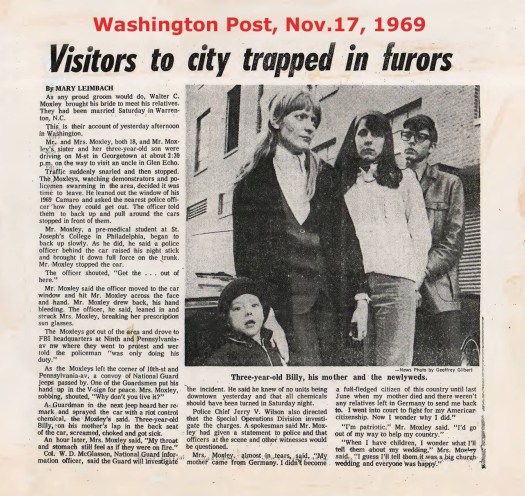
We protested the war in Viet Nam, which in 1969 was the largest protest in Washington D.C. until recent years. It was not easy and certainly not bloodless. The National Guard fired upon protestors at Kent State killing four students. Protestors were labelled radicals and extremists. I participated in many anti-war demonstrations in Philadelphia, yet strangely enough, made newspaper headlines along with my new husband and his sister the day after the 1969 rally in Washington, D.C., when we were caught in traffic. We were not part of the protest and yet were struck by police. A Washington Post reporter photographed us and wrote an article about us that headlined the paper the next day. (I must admit to being a bit melodramatic and a tad less than honest- not about what happened, but about my citizenship.)

At any rate, our protests were heard. The war in Viet Nam ended and Nixon resigned. Nixon was a crook, make no mistake about that!

We protested for women’s rights. We burned bras to signify our wish for freedom. Why? Women of today do not realize what was at stake or what freedoms they are so willing to give up. Women were beholden to their husbands to the degree that they could not get a credit card without their husband’s expressed and written consent. In 1972 the Equal Rights Amendment was passed and sent to the states for ratification.

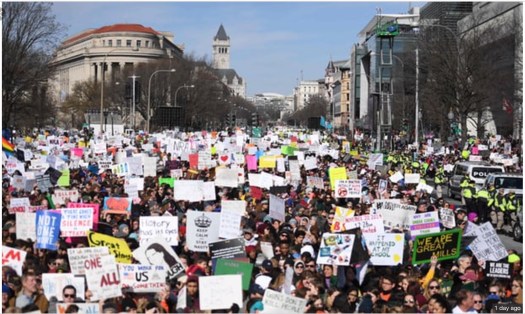
Protests do work! That is why I am so proud of this generation of students willing to take up the challenge and protest for legislative changes. I also hope Donald Trump is paying attention. In their youthful idealism, young voters are less likely to tolerate the corruption to which our Congress has turned a blind eye. Their days are numbered.

nyti.ms/2GdYyUO

Dark Days

I spend too much time reading news and posts on Facebook and too little time expressing my feelings and thoughts. Once in a while, I express myself on Facebook like this post:

“Although I am a Democrat, I thought it stunk of partisanship that disregarded the welfare of citizens when Clinton’s impeachment ended in acquittal. I loved Bill Clinton but knew in my heart that he 1.) lied to Congress and 2.) was guilty of obstruction of justice in the allegations of sexual misconduct against him. I loved him dearly- as much as I loved Al Franken but thought Clinton should have resigned just as Franken did for far less offensive behavior.

“We are now faced with a president who lies incessantly and attempts to obstruct justice at every turn- and that is without considering his long history of alleged sexual misconduct. This is about so much more than fondling and receiving sexual favors. This is about a foreign power attempting to undermine our democratic process. This is a matter of national security and our president prefers to call it a hoax and do nothing to protect our nation. Even his hand-picked National Security Advisor told Congress that the president has not directed or authorized strong countermeasures to Russia’s interference since our 2016 election. Trump has gone so far as to refuse to implement the sanctions voted upon by Congress in unprecedented bipartisan support.

“Will we as Americans allow this to continue? What can we do? What are we willing to do? 1.) Call your elected leaders in both the House and Senate and demand that they confront Trump over his refusal to impose sanctions. 2.) Register to vote and go to the polls this November to vote the GOP out of office.

“The only thing necessary for the triumph of evil is for good men to do nothing.”― Edmund Burke”

These are dark days. Special Counsel Robert Mueller is investigating possible collusion between Trump’s campaign committee and to determine if Trump attempted to obstruct justice by interfering in the investigation. Over forty appointed national officers including cabinet secretaries have been let go and nearly every federal prosecutor. He appointed federal judges with zero trial experience and secretaries that have long histories of litigating against the departments they now lead. Our nationally protected lands have been slashed and opened to mining and development. Measures enacted to preserve our environment are gone as are the laws protecting consumers from corporate greed.

Last night, Jeff Sessions, Attorney General, fired Andrew McCabe, former director of the FBI. He was fired at 10 p.m. Friday, within 48 hours of retiring, both to deny him his pension and to discredit him as a witness against Trump. Trump repeatedly called for his firing so how is it not political?

As of today, there have been 63 mass shootings including one in a south Florida high school that left 17 teens dead. The survivors are busy campaigning for reasonable gun legislation. God bless them! Maybe they will be the generation that saves us from ourselves.

Today is St. Patrick’s Day, a day that always makes me think about my son, Tod. He always celebrated this day.

Not everything is dark and foreboding. I am painting again. I am determined to learn how to watercolor. Most pieces are mediocre at best but a few came out decent.