I no longer recognize my world.
Up is down and down is up.
Truth is lost in a fog of lies.
What is honor? Does integrity matter?
Is kindness a failing of the weak?
So many questions unanswered.
I gained self-respect and dignity
By Choosing to be honest and kind.
I put behind shame and dishonor
By embracing what was moral and good.
In this upside-down world before me,
Do these qualities matter at all?
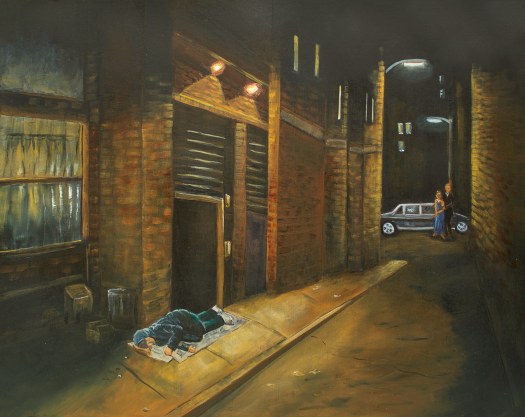
The disabled are the targets of mockery and
Women objects of sexual assault.
The lives of black youths are expendable,
And brown children languish in cages.
The rich stand high on their pedestals
While the poor go hungry and cold.
I no longer recognize my world.
Up is down and down is up.
Our soul’s nobility is gone.
Where is honor? Where is our integrity?
Where is our compassion for our fellow man?
So many questions unanswered.
My sister, Liz died this week. Her death made me think about our family and how fractured it is, so I wrote this poem:
We were broken.
We were children brought up with abuse, lies and recriminations.
We were humiliated, put down and made to feel shame,
We were blamed for the failures of our parents
And made to feel responsible for their emotional contentment.
We were pitched one against the other and never learned to unite.
The accusations we internalized as children
Stayed with us until the bitter end.
We were broken.
We played roles,
But we were all too broken to play any of them well.
One became the Caretaker, but her own youthful needs stood in her way.
One became the Scapegoat, but her endless fight against this label
Only set her up for more blame and reproach.
One became the dependent Baby whose needs could never be met
By siblings too self-absorbed and lacking any sense of self-worth.
We were broken.
One became the Instigator who perpetually stirred up discontent.
And the parents who defined us? They stood on their pedestals even after death
With their long-gone but still audible voices directing the play.
Never criticize them. Never blame them. Never speak ill of the dead.
We were their victims and we were broken-
Too broken to unite and lift each other up.
Ever fragmented and tearing each other down.
We are broken still today.
Liz was a Christian, and I wonder how she reconciled the turmoil and divisiveness within our family to her beliefs? One way was by Gaslighting and rewriting our history. In the end, we must all cope somehow. Farewell, Liz. Hope you are blissfully reunited with your daughter.
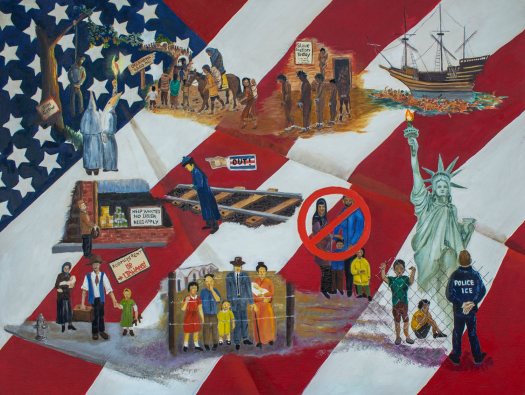
Coming to America, oil on canvas by artist, Dorothy J. Riley
Our history of immigration is checkered, at best. The flood of settlers from Europe at the turn of the 17th Century destroyed thousands of Native Americans and their villages. We then imported thousands of slaves from Africa and other places but they and their American born offspring were not counted as citizens. The remaining Native American peoples were forcibly evicted from the Eastern coast in 1830 by Andrew Jackson and Martin Van Buren to make room for white settlers. The Indian Removal Act is better known as the Trail of Tears.
While the Civil War freed the slaves, African Americans continued to be treated as second class citizens supported by discriminatory policies in education, housing, and voting restrictions. Jim Crow practices served as a constant reminder that white Americans believed African Americans inferior.
Irish and Italian immigrants were not wanted because they were often poor when they arrived on our shores, but mostly because white Protestant Americans feared the influx of Catholicism. The Irish were in fact, considered less “valuable” than slaves as laborers and were used for constructing the canal in New Orleans were the high rate of death made it too “expensive” to use slave labor. It is estimated that between 8,000-20,000 Irish laborers died building the canal.
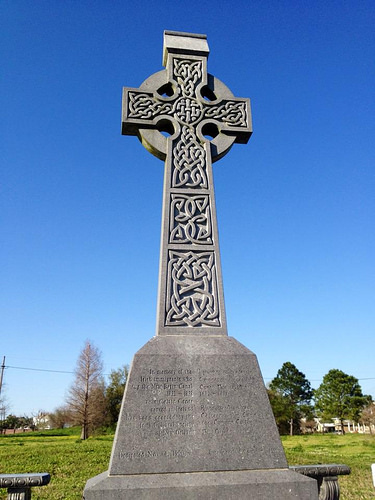
Kilkenny Cross in New Orleans honoring the thousands of Irish immigrants who died building the canal.
We then imported thousands of Chinese to build the Transcontinental Railway. (One of my previous posts.) When we no longer needed their labor, we sent them back to China and banned Chinese immigrants.
Our next target were the Japanese during WWII. To quote Wikipedia, “The internment of Japanese Americans in the United States during World War II was the forced relocation and incarceration in camps in the western interior of the country of between 110,000 and 120,000 people of Japanese ancestry, most of whom lived on the Pacific coast.”
Most were U.S. citizens, many were born in the U.S., owned property and businesses, all of which was confiscated by the government. Many were paid for their lost properties but the compensation was far less than 10% of the actual value. Call it what you may, they were imprisoned for the crime of being Japanese or of Japanese descent.
Two other noteworthy acts of discrimination occurred, both recently under the administration of Donald Trump. The first of these was the “Muslim Ban,” allegedly, to deter terrorists from reaching our country. Trump’s first attempts to ban Muslims were struck down by the courts, but after repeated attempts and by changing the language of the executive order, the last attempt succeeded. Strangely enough, Saudi Arabia was not on the list of banned immigrants despite 15 of the 19 persons who attacked our nation on 9/11 being citizens of that nation!
The most heinous act was the removal of over 2,500 children from South American families seeking asylum in our country. A court overruled the separation of families, but many parents were deported without their children and hundreds of children are waiting to be reunited. Worse, many of the children who were returned had body lice, were dirty, malnourished, were physically and sexually abused and severely traumatized. The photos of these children kept in chain-link cages is what inspired my painting, “Coming to America.” How could we do that?
Riley, O’Malley and O’Shea-
Remember when you were not welcome on these shores?
Ricco, Ferrari and Rizzo-
Remember when to you they closed the doors?
Wan, Wong, Chang and Bay-
Once you were cast out from this great land.
Kobayashi, Nakamura and Ito-
You were dispossessed; sent to internment camps.
Azikiwe, Akintola and Cisse,
Your owners took your names and gave you theirs,
Like property, you were auctioned off and sold,
Not white, not equal you were told.
Rodriguez, Gonzales and Lopez-
You are now much reviled and held at bay,
How quickly they forget not long ago,
It was they regarded as the foe. Ω
Sometimes bitterness creeps into my poetry the way a tear escapes even when you don’t want to cry. While many of my poems deal with vulnerability and pain, I usually express these with words of sadness and not bitterness. There is nothing noble about acrimony.
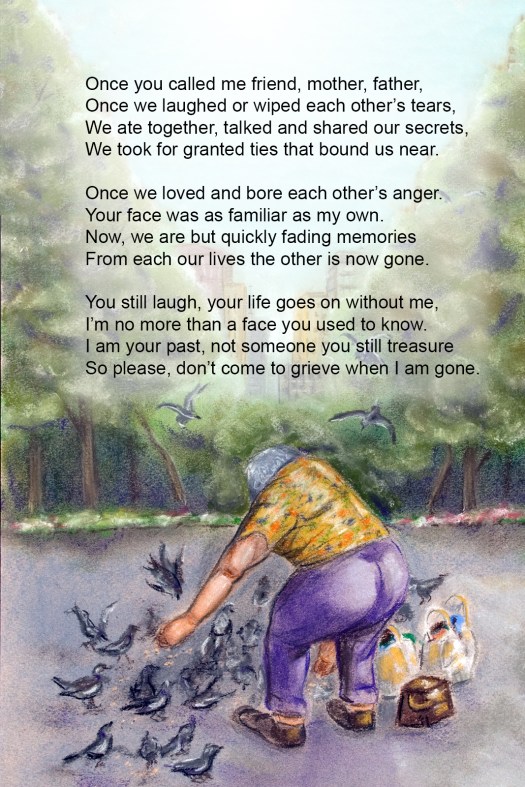
(The bag lady feeding pigeons in the park is an old pastel of mine.)
 I no longer recognize my world.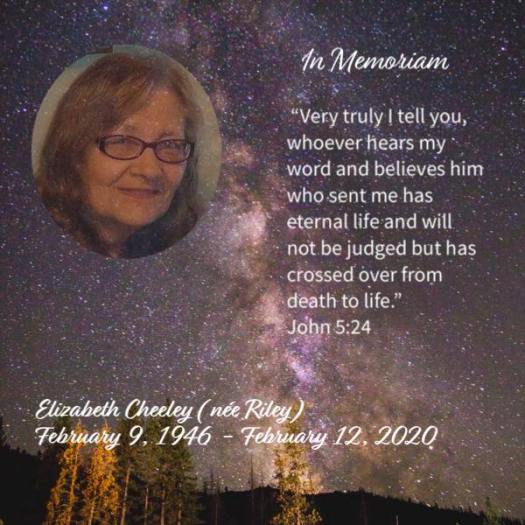
 dottieriley