We Were Broken

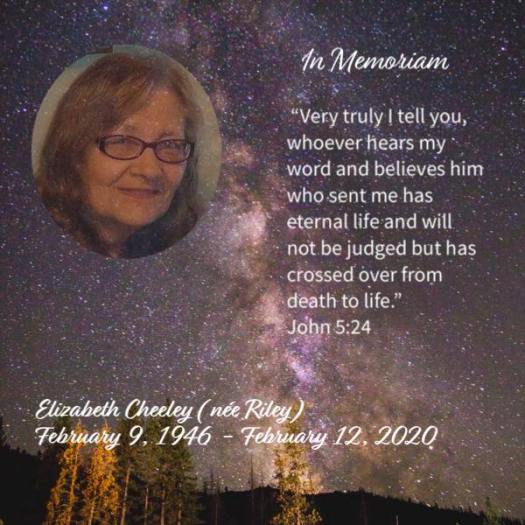
My sister, Liz died this week. Her death made me think about our family and how fractured it is, so I wrote this poem:

We were broken.
We were children brought up with abuse, lies and recriminations.
We were humiliated, put down and made to feel shame,
We were blamed for the failures of our parents
And made to feel responsible for their emotional contentment.
We were pitched one against the other and never learned to unite.
The accusations we internalized as children
Stayed with us until the bitter end.
We were broken.

We played roles,
But we were all too broken to play any of them well.
One became the Caretaker, but her own youthful needs stood in her way.
One became the Scapegoat, but her endless fight against this label
Only set her up for more blame and reproach.
One became the dependent Baby whose needs could never be met
By siblings too self-absorbed and lacking any sense of self-worth.
We were broken.

One became the Instigator who perpetually stirred up discontent.
And the parents who defined us? They stood on their pedestals even after death
With their long-gone but still audible voices directing the play.
Never criticize them. Never blame them. Never speak ill of the dead.
We were their victims and we were broken-
Too broken to unite and lift each other up.
Ever fragmented and tearing each other down.
We are broken still today.

86364342_3278156908864589_3282171637750824960_n

Liz was a Christian, and I wonder how she reconciled the turmoil and divisiveness within our family to her beliefs? One way was by Gaslighting and rewriting our history. In the end, we must all cope somehow. Farewell, Liz. Hope you are blissfully reunited with your daughter.

Complicated Families

32904617_2118638778149747_3200258966374318080_o
Sofie’s Girls

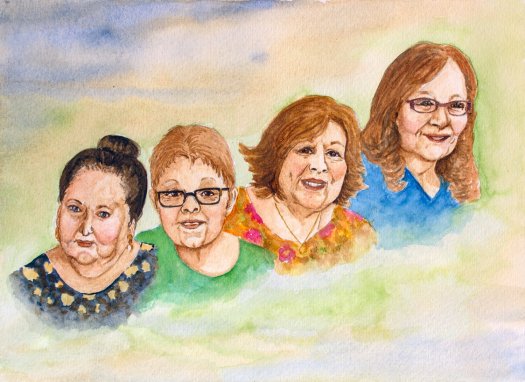
My family relationships are complicated, but then, that may be true for most of us. I have five sisters and am close to only one, the youngest. I get along OK with the next youngest, but her life is problematic, and I may not be her most sympathetic listener. She struggles with an addiction to pain pills, the same affliction that robbed my son of his life. My efforts to encourage her to seek treatment has succeeded in making her avoid talking to me.

My mother, Sofie, had five daughters, the youngest of which is institutionalized for severe brain damage. My mother had Pleurisy while pregnant and in 1960, doctors did not fully recognize the threat of x-rays to a developing fetus. The sister to whom I refer as my youngest, Linda, has a different mother.

With my other two sisters, Marie and Liz, my relationships are often either strained or estranged. If they had to list which of their sisters they got along with the best, I would place at the bottom of their list. Strangely enough, none of them (Sofie’s daughters) have a relationship with Linda, and I cannot explain why. Her name would not appear on their roll of siblings.

Members of my family treat me like a pariah. That too, I do not understand. I have never done any of the truly hateful and hurtful things to them that they have done to me. My oldest son has not called me in years to say hello while his wife never speaks to me at all. I took this up with my therapist more than once because it hurts me deeply, but I don’t like where it always ends up. Could my sisters honestly be envious of me? My son, Tod, thought so. Tod always said that I was a tough act to follow. I accomplished much in my life and did it despite substantial childhood setbacks. I survived sexual abuse by my father, an alcoholic mother who rejected me, foster homes, and institutions. Yes, I have significant failings. I am damaged. I suffer from Post-Traumatic Stress Disorder, and I do not know how to build and maintain healthy relationships. My daughter-in-law calls this “just a poor excuse” for not being a better mother, but her opinions about my mothering skills came from my son, Michael. He envied and resented his younger brother and called him my “golden boy.”

Without the love and support of my family, I seek validation of my worth as a human being in the things that I accomplish. I earned a Master in Social Work when none of Sofie’s other daughters graduated high school. My sisters resented me for that. For decades, I had to listen to the incessant refrain that I think that I am better than them, and now, I am called one of the “educated elitists.” Sigh!

Thanks to my education, I held better-paying jobs and lived in better neighborhoods. My worst nightmare was that my sons would end up living the life of poverty that I worked so hard to escape. Those fears were unfounded as both of my sons did well. I own two houses, or should I say, I carry mortgages on two! I am in debt, but I have savings as well. Having more money would be a nice thing but my income exceeds my expenses, and I live comfortably. I mention my finances first because this society measures success by our means.

My art has brought me other measures of success. While I am self-taught and most of my work is mediocre at best, I have managed to get a few paintings accepted into museum collections and earned several national public service awards. As a member of a national military affiliated volunteer organization, I received numerous honors as editor and graphic design artist. I need this validation. You see, without the love and support of family, I constantly doubt my worth. I would gladly exchange all of my awards for a family that loves and cherishes me.

My son, Tod loved me dearly, but he is no longer living. I am grateful beyond words to my sister, Linda and her family because they do love and appreciate me. I love them dearly too. For obvious reasons, I am closer to Linda’s daughters than I am to my grandsons. I wish that were not true, but it is. I take comfort in knowing that no matter how estranged Michael is from me, he is a great father to his sons. I wish that I did not feel so alone and isolated, but life goes on. Ω

Tod with One “d”

Tod portrait
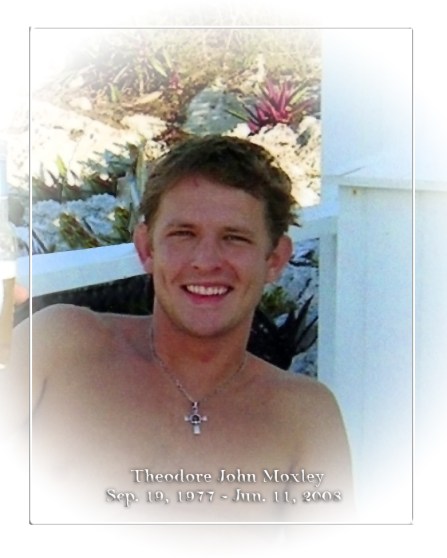
Portrait of Tod Moxley

His name was Theodore John Moxley born Sept. 19, 1977, and he was my youngest son. Tod was a beautiful boy with dark blond hair, green eyes, and dimples. His personality can only be described as effervescent, and everyone loved him except his teachers at school. Tod simply could not be contained or controlled. That, unfortunately, is a trait shared by many highly intelligent people.

There is nothing Tod wanted more than the love and approval of the most significant men in his life- his father and his older brother, but he was never able to find either. His older brother alleges that he made peace with Tod in the years before his death, but I know that is not how Tod felt. We last talked about his older brother a month before he died.

When Tod gave his heart, it was completely and without reservation. He loved me and adored his wife. He loved people- all people regardless of race, religion or economic status. His friends included people from all walks of life. More than anything, he was a comic who made others laugh and a listener who made others feel important. In short, people loved being with and around him. He was incredibly beautiful in body and spirit.

My oldest son was envious of Tod and my relationship with him and called him “my golden boy.” Michael did not understand that it is easier to express love to someone who accepts and returns my affections. I love Michael too, but it was and continues to be hard to cut through the layers of resentment.

Tod was deeply troubled. His father rejected him from birth to the age of 15 and then made his love and approval conditional. That wounded him deeply. Tod’s response to conflict was to escape through drugs. Before he turned 18, my reaction was to place him in rehabilitation centers whenever I knew he was using, but little did I know that the close friends I trusted to help him outside of treatment were the ones supplying him with drugs. No, I do not see Tod through rose-colored glasses nor do I blame others for his failures. His missteps in life were as big as his personality.

What surprises me is how people loved him when he was alive and continue to love him today even though he is gone.

Tod and Annie from Jennifer
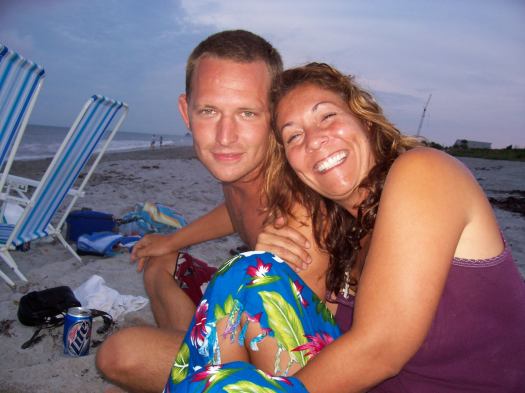
Tod and his wife, Annie, 2007.


Who’s Who in My Family

Family tree 2017-unframed-yellow-plus-text

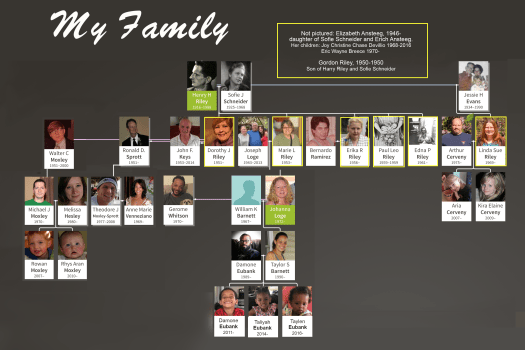
As I write about myself and members of my family, it might be to my reader’s advantage to post my family tree to serve as a ‘cast of characters.’ Refer back to this as necessary. I have not included my grandparents and aunts and uncles; just my immediate family. My siblings have yellow borders added and I included their children and grandchildren.


Family Myths and Lies

FamilyMythsandLies-WP

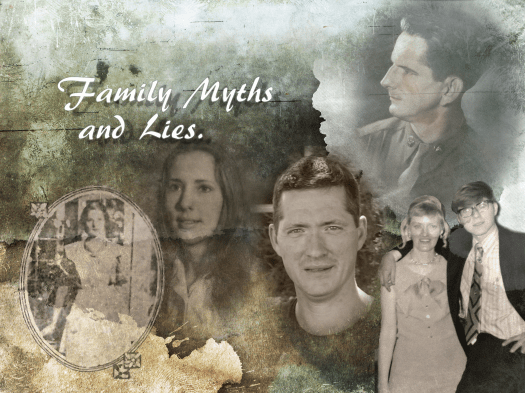
My family is rife with myths bordering on alternate realities. Some people might think the stories they repeat are lies. Until recently, I did too, but what is a lie? Anything that is not true, not factual? That is an over-simplification.

Take a look at the current political climate. People firmly believe in candidates and positions that are refuted by facts. Beliefs are not connected to truth, and when they are, it is almost by accident. We hold to facts that support our beliefs and dismiss all others. Families do that too, and family myths are as difficult to alter as religious beliefs. Take my own family, for example.

My father was an enigma. He was loving and affectionate. Were it not for him I would never have known love at all, and yet he abused me for most of my childhood.  My father was a master at weaving myths into the fabric of our lives. His mother died when he was a toddler, and his father and grandparents raised him. He told us that his mother, a Cherokee Indian, was killed by an Indian man to whom she was promised in marriage. Of course, he told us that she was no common Indian maiden but a Cherokee princess. While I dismissed the princess part before I was an adult, he always insisted, and we always believed that she was Cherokee, or at the very least, half Cherokee by birth. That, we believed, is from whom my father inherited his high cheekbones and the slight hook in his nose. He told my mother the same thing, and she too believed that her husband was part Native American until the day she died.

When my younger sister, a dual national, had to declare her citizenship, she obtained a copy of my father’s birth certificate as part of her naturalization process. I was in my mid-thirties when I first saw this document and saw that his mother’s race was listed as ‘white.’ White? How was that possible? In 1916, no native American would be listed as ‘white’ on a birth or marriage certificate. My world dropped out from under me. A piece of my identity had been ripped from me and left me questioning everything I ever knew or believed about myself and my family.

You see, this was just another myth constructed by my father. He had two names and two birth dates and always used ‘Gordon’ as his middle name. After he had died, I learned that he never had a middle name at all, and his tombstone at the Veteran’s cemetery bears the wrong first name; the only name by which  I knew him. He told countless myths, and my sisters and I used to laugh at most of them, but we never guessed that even his name and ethnic origins were constructive lies.

My mother was not given to spinning yarns, but my sisters were good at it. Heck, I spun a few of my own until I saw my father’s birth certificate. After that, I resolved never again to alter any fact in my life no matter how much the truth made me squirm. There are things that I will never tell a soul, but I will never knowingly lie. I came to believe that no truth could be as hurtful as the myths and lies I’d been told.

My oldest son’s father, my first husband, rivaled my father in confabulating alternate realities. Walter shared other characteristics with my father: he was affable and charming, and just like my father, he abused the ones he loved most. Walter had a quirk that my father did not. He was too insecure to share affections. It was as if he feared that to love someone else meant that person loved him less. For example, as proud as he was of his son, he accused me of loving our son more than I loved him and was jealous of the attention I paid our son.

I had grown accustomed to Walter’s many stories and learned to separate the myths from the facts by talking to his mother. After our divorce, I no longer cared about his self-aggrandizing stories but that is when they did the most harm. The combination of distorting truths and weaving tales of near mythical proportions, paired with his insecurities and his need to be loved more made him draw our son into his fictions. There were no versions in which he was not the victim of my malevolent deeds.

I learned later that Walter liked and praised me to others. He told them how smart and talented I was and valued the few pieces of my artwork that he kept after I left him. Nearly two decades and three wives after we parted, I saw floral arrangements and drawings in his house that I had made. How they survived his subsequent wives is puzzling, but there they were! It would seem that he reserved his rancor of me only to ensure his son’s love. To be more precise, that his son loved him more than he loved me.

Like my father and like his father, my son lives in a world filled with myths and inventions. In his confabulations, he was raised by his grandmother, and I had no time for him; I am the reason his father took drugs; I destroyed his life, and I did not love him as much as I loved his younger brother. Like his father, Michael feared that my love for my youngest son meant that I loved him less.

The myths within my family have done nothing except hurt us, and yet oddly enough, they are constructs meant to avoid pain. Until very recently, I thought of these myths as venomous lies and detested them.  Then I had a eureka moment. Every person in my family who rewrites history and presents alternate facts is doing so to help them fill a painful gap or patch together pieces of their lives torn by tragedy and disappointment.

My father resorted to confabulation after her lover murdered his mother. In 1918, that was so scandalous and shameful that no one was allowed to talk about her in front of him. My father grew up with more questions than answers and resorted to creating his version of his mother, and ultimately his version of himself. His myths shaped his reality.

My sisters grew up with an abusive father, dire poverty and a mother who looked for solace in the bottom of a beer bottle. We were sent into foster homes and institutions, and everything about our lives was torn and sullied. This is not the childhood they describe to others. They will admit to our mother’s alcoholism and our destitute conditions as if they were but footnotes in their greater adventures.

My sons also knew trauma and rejection. My oldest son has his father’s ability to rewrite history and recreate reality to avoid inner conflict and pain. Most of Michael’s myths and distortions center around me, beginning with the lies his father told him. What is most interesting is how these myths and lies snowballed. They started with occasional hiccups in our relationship and culminated in a breach so wide neither of us can reach across anymore.

Back to my eureka moment. I now understand that every myth, every yarn is there to piece together a torn life. They are stitches and patches that make life endurable; that make it wearable. I wonder- if they deeply and honestly questioned themselves, could they admit that these are myths, or have they deluded themselves into believing they are truths? It also makes me wonder what myths I incorporated into my version of reality and what those myths might be.