Escaping From Irma and Other Thoughts

This year’s hurricane season has been awful! Houston was slammed by Harvey in August and sustained severe flooding. Houston received up to 52 inches of rain in just a few days. A month later, Irma wound up the Caribbean and was forecasted to travel up the west coast of Florida. It was one of the biggest storms on record: over 3oo miles wide with wind speeds up to 175 miles per hour; and as I write this and less than two weeks later, Puerto Rico is presently under assail by another category five storm, hurricane Maria.

I planned to stay home during hurricane Irma and hope for the best, but a friend talked me into evacuating. Of course, all of my Facebook friends were urging me to do the same, so the choice between facing down a possible direct hit from a category five hurricane versus leaving along with 7 million other Floridians was an easy one. Evacuate.

The drive out of Florida was arduous. The highways were packed and until we reached Tallahassee, for many hundred mile stretches at a time, we could drive no faster than 25 miles per hour. By midnight we looked for a rest stop to sleep a bit and recover. At the first rest stop I had a wonderful experience; a Déjà vu of memories more than fifty years ago when things like Woodstock, love, and peace reigned. Dozens of people representing every age, gender, economic status and many races stood in groups sharing their experiences. A white man in designer clothing was talking to a Latino wearing faded jeans and a worn shirt. A young woman with several tired and cranky children allowed an old couple to share treats with their children and speak words of comfort to them. The storm was a great equalizer. Skin color, income, and education level did not seem to matter to people sharing a common threat. Unfortunately, George thought this rest stop was too bright and loud and believed that he would not be able to sleep, so we moved on to the next rest area.

One more thing. Florida state troopers (Florida Department of Law Enforcement) patrolled the rest stops, welcomed evacuees to stop and sleep, and directed cars to available parking spaces. They were kind and helpful. In addition to the standard restrooms, every rest stop had many portable toilets set up to reduce wait times.

Finding a hotel room was as difficult as the long drive. Millions of evacuees meant that there were no hotel or motel rooms available in Alabama or Mississippi. We ended up driving all the way to Metairie, Louisiana, a city about ten miles from New Orleans.

Two days later, we drove back home. Many gas stations had either no power or no gas, and the traffic was heavier than when we exited. I was fortunate. The storm veered east. Tampa was not hit by the eye of this storm but suffered only strong winds and heavy rains. I sustained just a few broken tree limbs. While we lost power in my neighborhood, it was back on by the time that I got home.

There are so many other things that I do not know how to talk about. I received a lot of love and support from family members, and I keep wondering why my son never called or texted me to make sure that I was ok. Before we evacuated, I asked to talk to my grandsons, but my son replied by text that he was too busy with meetings and soccer to arrange that call.

Yesterday was Tod’s birthday. He is my youngest son who died nine years ago. I miss him. Tod cared about me and often called me “just to talk” and to let me know what was going on in his life. He enjoyed talking to me and sometimes called for no reason other than to relay a story he knew I would enjoy. I know Tod would have called me before Irma because in 2004 when Florida had four hurricanes, my son came to stay with me to make sure that I was ok. Storms are traumatic events and many times these past weeks, I thought about him. Happy belated birthday, Tod! Fair winds and following seas.


My Colonial Riley Ancestors


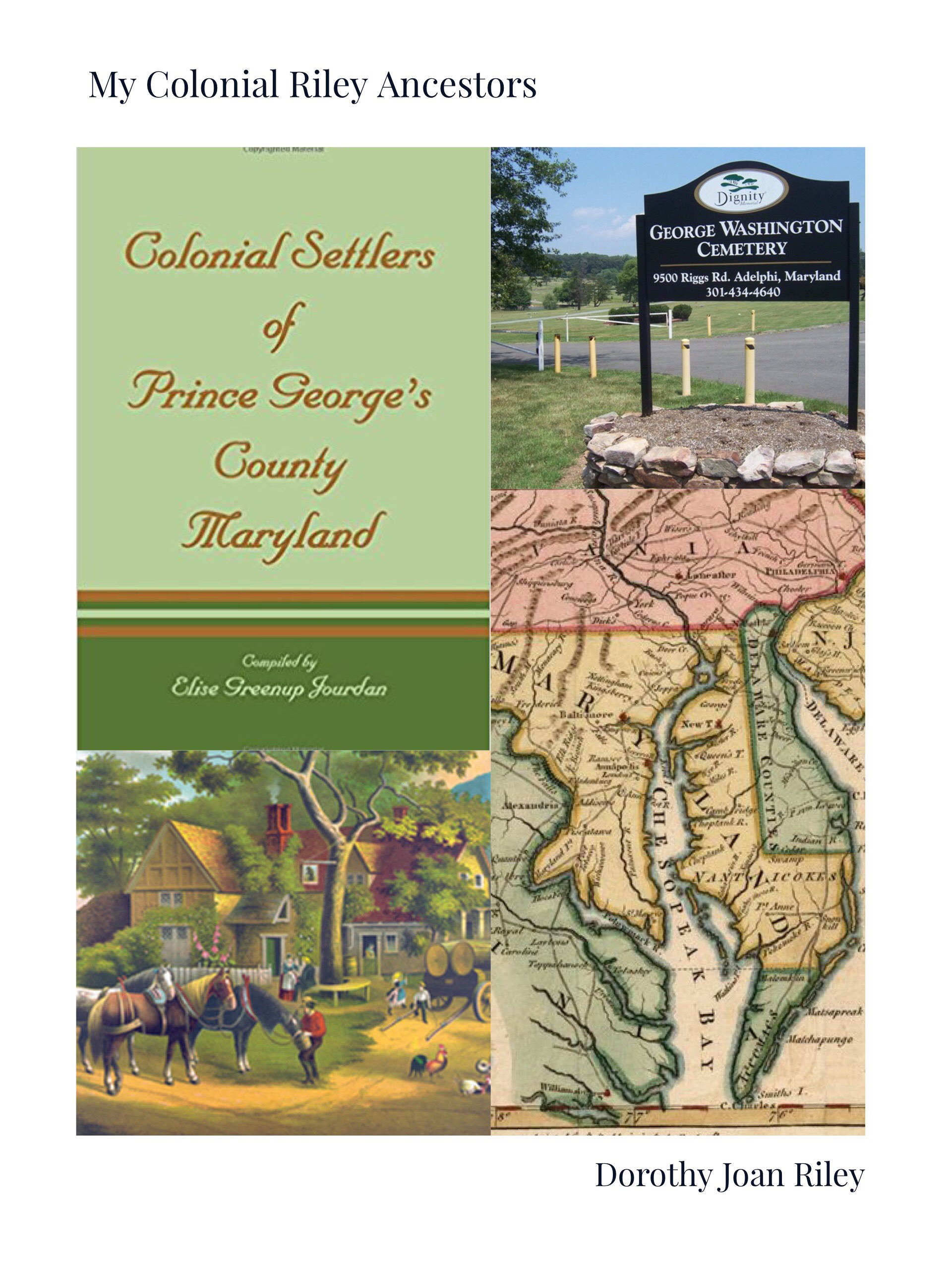
Family trees bring history to life. Those who settled this great nation and fought Indians and who fought the American Revolution are not just people from a bygone era. They are my ancestors- my family.  I’ve traced my family tree on my father’s side back to Miles Reilly born 1614 in Ireland, who with his family and son, Hugh Aodh Riley, born in 1650 in Ireland, immigrated to this country and settled in Prince George’s County.

Most Irish immigrants were poor indentured servants and many were Catholics, but Miles was a Protestant landowner and merchant. Why did he choose to leave Ireland? Possibly because Ireland experienced repeated wars between Catholics and Protestants and ruling kings and clans. The new world may have held the promise of peace, prosperity, and adventure. Miles Reilly left Ireland and settled in Prince George County where his son, Hugh, married Margaret Ploumer. Hugh and Margaret gave birth to nine children, all of whom I can only presume were educated because they also became landowners and merchants. Their fifth son, Eliphaz, is my direct ancestor.

Eliphaz was born in 1689. He lived in Prince George’s County all his life. Eliphaz married Elizabeth Burkett in 1714 and had ten children. He is on record as purchasing “the Hop yard tract of land” (land situated between Friendship and the Potomac River). He is on record requesting a license for an ordinary or tavern in 1750 and is listed signing a petition for the erection of a new county from Prince George’s and Frederick’s, which would become known as Montgomery County. He was a member of the Rock Creek Episcopalian Church of England. In his will dated December 8, 1759, he left the Hop yard to the children of his sons James and Jeremiah. Other than these few records, there is very little known of Eliphaz.

What was Maryland like in those years? Prince George County is described as a flourishing settlement with as many as 2,500 residents, a bit more than half of which were indentured servants and slaves. Their lives were almost solely agrarian, and tobacco was the biggest cash crop necessitating a large, cheap work force (hence, the need for slaves and indentures). They did not consider themselves Americans. They thought of themselves as English colonists who swore fealty to King George and the English crown.

I am struggling to picture their farms and farm houses. I struggle to picture them working in the fields, washing clothes and making soap. Likely they did not have to do all of these things themselves. They owned slaves, and landowners were in a class of their own with the right to vote and make decisions for the community. Landowners were invested in being as genteel as possible and dressed their children fashionably, sent them to school and delighted in European art, music, and culture. Despite this, life was difficult. Medicine was not ‘modern,’ and Indians raided remote farms. Daily life could not have been that easy even for the more privileged. I also cannot imagine their reactions when their children swore Oaths of Allegiance to Maryland and fought for independence from England.

By the way, acknowledging their status as slave owners is not a statement of approval. That was their life. Eliphaz’ grandson, Rev. Gerard Riley, was an abolitionist and active in the Underground Railroad. Different times, different values.

Poems For My Sons

Son-poem

A Poem I wrote over a decade ago for my son, Michael:

The wide-eyed grin of my baby boy
Smiles back at me from pages worn.
A little boy with ball and mitt,
Next older, opening Christmas gifts.

The troubled adolescent frowns,
But other images I own…
A boy building sand castles upon the shore,
Riding bikes, and there are more….

A boy who chased through trees and moors,
A young man who a uniform wore.
Photographs of past loves and loss,
Beside his bride, content and grown.

Now separated by time and space,
Now thrust apart by memories torn,
I miss my son, flesh of my flesh,
I miss his smile and his embrace.

Still, in these pages that I turn
There yet remains the younger boy,
Who can recall the moments when,
He knew that he too loved me then.

One written for my son, Tod:phonecalls-from-heaven

Phone Calls From Heaven

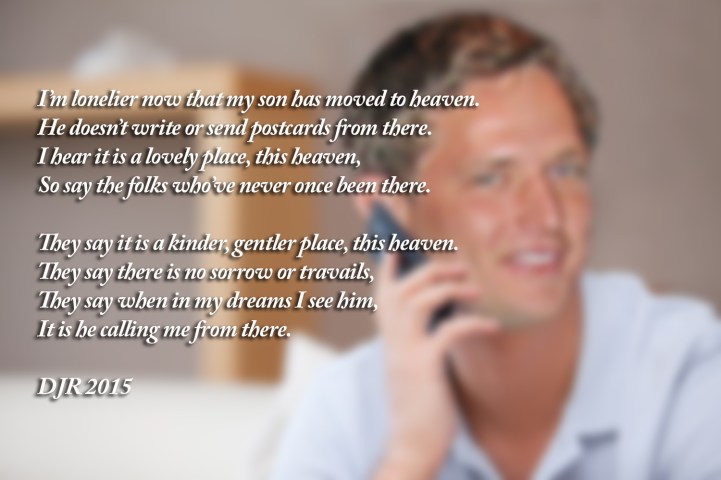
I’m lonelier now that my son has moved to heaven.
He doesn’t write or send postcards from there.
I hear it is a lovely place, this heaven,
So say the folks who’ve never once been there.

They say it is a kinder, gentler place, this heaven.
They say there is no sorrow or travails,
They say when in my dreams I see him,
It is he calling me from there.

DJR Oct 2015


Tod with One “d”

Tod portrait
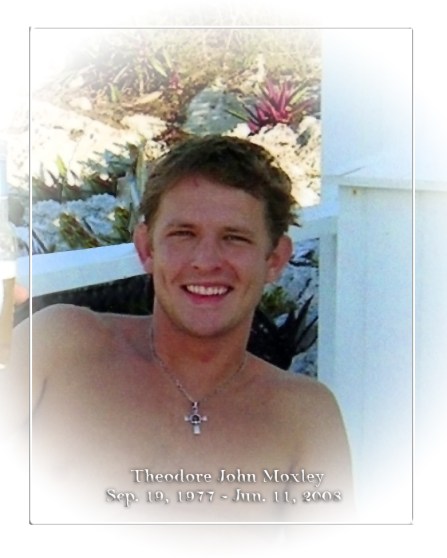
Portrait of Tod Moxley

His name was Theodore John Moxley born Sept. 19, 1977, and he was my youngest son. Tod was a beautiful boy with dark blond hair, green eyes, and dimples. His personality can only be described as effervescent, and everyone loved him except his teachers at school. Tod simply could not be contained or controlled. That, unfortunately, is a trait shared by many highly intelligent people.

There is nothing Tod wanted more than the love and approval of the most significant men in his life- his father and his older brother, but he was never able to find either. His older brother alleges that he made peace with Tod in the years before his death, but I know that is not how Tod felt. We last talked about his older brother a month before he died.

When Tod gave his heart, it was completely and without reservation. He loved me and adored his wife. He loved people- all people regardless of race, religion or economic status. His friends included people from all walks of life. More than anything, he was a comic who made others laugh and a listener who made others feel important. In short, people loved being with and around him. He was incredibly beautiful in body and spirit.

My oldest son was envious of Tod and my relationship with him and called him “my golden boy.” Michael did not understand that it is easier to express love to someone who accepts and returns my affections. I love Michael too, but it was and continues to be hard to cut through the layers of resentment.

Tod was deeply troubled. His father rejected him from birth to the age of 15 and then made his love and approval conditional. That wounded him deeply. Tod’s response to conflict was to escape through drugs. Before he turned 18, my reaction was to place him in rehabilitation centers whenever I knew he was using, but little did I know that the close friends I trusted to help him outside of treatment were the ones supplying him with drugs. No, I do not see Tod through rose-colored glasses nor do I blame others for his failures. His missteps in life were as big as his personality.

What surprises me is how people loved him when he was alive and continue to love him today even though he is gone.

Tod and Annie from Jennifer
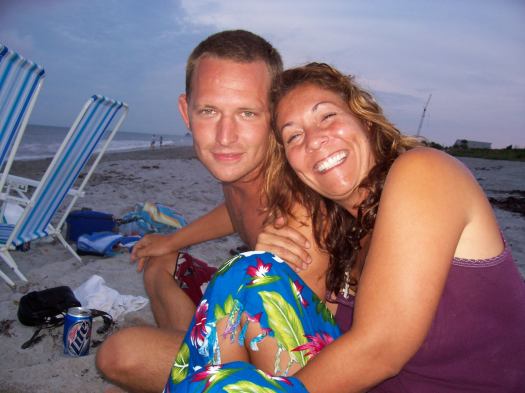
Tod and his wife, Annie, 2007.


Who’s Who in My Family

Family tree 2017-unframed-yellow-plus-text

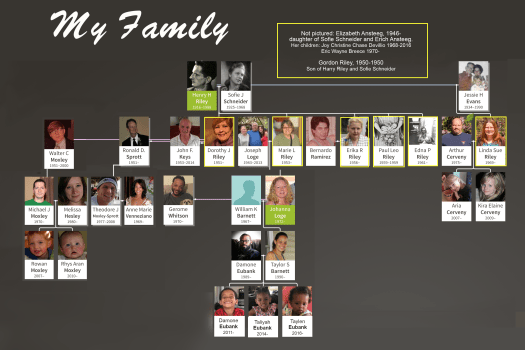
As I write about myself and members of my family, it might be to my reader’s advantage to post my family tree to serve as a ‘cast of characters.’ Refer back to this as necessary. I have not included my grandparents and aunts and uncles; just my immediate family. My siblings have yellow borders added and I included their children and grandchildren.