Rest in Peace, Anna.

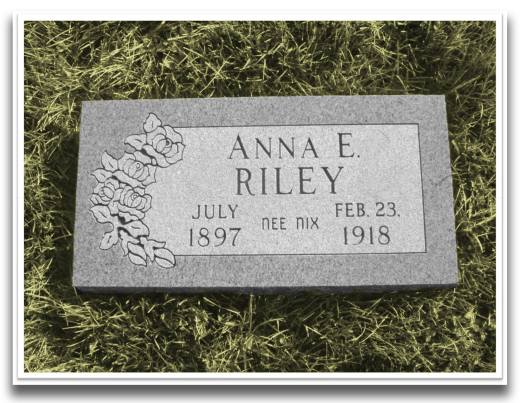
One-hundred years after the death of Anna E. Riley (nee Nix) and I finally have the closure denied to my father. Anna at long last has a tombstone, and I finally know what happened to her baby daughter, Grace E. Riley.

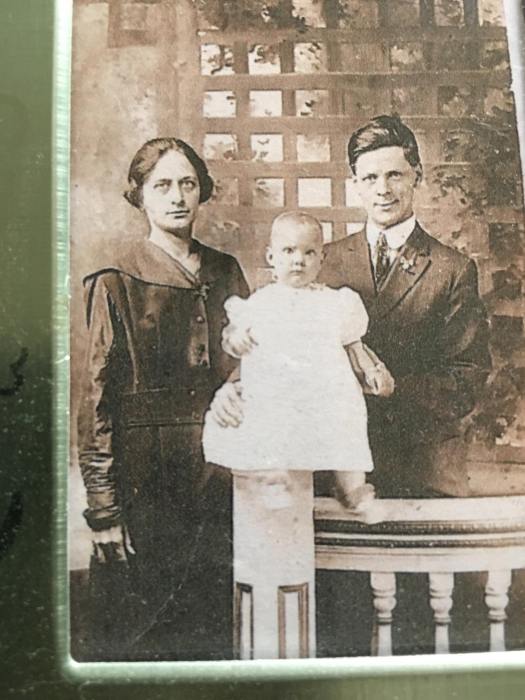
My father never knew more than myths and rumors about his mother. He could not talk about her to his family and from childhood built a myth around the little information that he had.  He knew that she was murdered by a lover who then killed himself. That much was accurate, but in my father’s myth, his mother was a Cherokee princess killed by a brave to whom she had been promised in marriage after she married my grandfather instead.

Anna was not Cherokee. She was of Irish descent, and then there is the ‘princess’ part. How is it that all white people of his generation who had Indian heritage insisted that his native American ancestor was a chief or a princess? At any rate, nineteen-year-old Anna was killed by a man much her senior who was enamored of her. She may or may not have committed adultery with him. She met him at the Grand Hotel in Cincinnati in February 1918 and told him that she would not leave behind her family to be with him. Overwhelmed with grief, he killed her, wrote a seven-page suicide letter explaining all of this, then killed himself. In the hotel room with them was Anna’s eight-month-old daughter, Grace Riley.

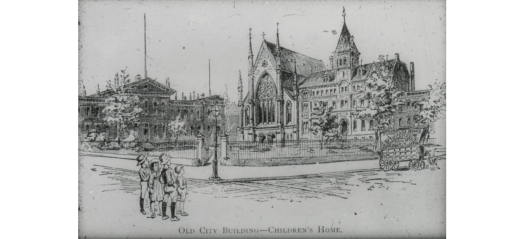
After Anna’s death, my grandfather, Wilford, and his three-year-old son, Henry (my father), moved in with Wilford’s parents. Baby Grace was immediately placed in one of several children’s homes in Cincinnati. After that, she disappeared. No trace of Grace appeared in any of my genealogy searches. I never knew what happened to her.  I always mourned her. How could her family care so little about her?  Neither Anna nor Wilford’s parents were willing (or able?) to take her in. What kind of people voluntarily relinquished their child, their grandchild?

Childrens-Home-Cincinnati

One hundred years later, I finally learned what happened to Grace. She was adopted by a couple that according to the account of one of her daughters, loved, even ‘doted’ on her. (Out of respect to her family’s right to privacy, I will not use their surnames.) Grace was renamed Kalya. She had a happy childhood, grew up, married and had five children of her own.  I am so happy to know that she was dearly loved by her parents and her children and I no longer pity her. Through adoption, she escaped the lies and the secrets that shaped my father who grew up feeling a deep sense of shame and inadequacy.

36438155_2338987152783817_6809375669454110720_n

While some of the shame was of his own making, I do not doubt that my father’s family played a role in his sense of inadequacy. Henry became Harry, and he left his family at the age of sixteen. He assumed Grace Riley’s birthdate which made him old enough to join the Army without parental consent. That is why he had two birthdates in his military records. His correct date of birth was not a part of his military records until he had to receive a top-secret security clearance from the Army for his role in the Nurnberg trials. My father divorced himself from his family so completely that he told me that he had no living relatives, no aunts, cousins or uncles. That too was a lie. After my father died, I learned that his aunts lived just a few blocks from us when we lived in Newport, Kentucky 1961-1962.

Grace, a/k/a Kalya escaped whatever drove Harry’s demons. I am happy for her and her children. They grew up feeling loved and cherished. They likely did not experience physical or sexual abuse or have their family torn apart by alcoholism. I inherited enough of my father’s shame that I don’t want them to know what it was like to grow up in Harry’s household. His inadequacies colored all of his children’s lives. It is enough for me to know that Grace escaped that family history and experienced something better. Bless her and her descendants!

The final part, and that which with I started this. Anna Riley was buried without a tombstone or anything to mark her life or her passing. Her affair made her an anathema to my father’s family, and my father never knew where his mother was buried. It took some searching for me to learn where. I tried to visit her grave last year, but there was no stone, and even the plot marker was deeply buried beneath the soil and grass. This year, I bought her a headstone. Anna deserves this much. Through her son and her daughter, she is the ancestor of two completely different families tied together only through her DNA. I cannot despise my grandmother for her possible infidelities. By the time that she died, she had lost two children and knew nothing except poverty and want. What nineteen-year-old does not wish for more? In the end, she chose her family and died for that decision. Rest in peace, Anna. Your life was not in vain.

36528631_2183199061693718_1850437769868869632_o


I Miss You, Son.

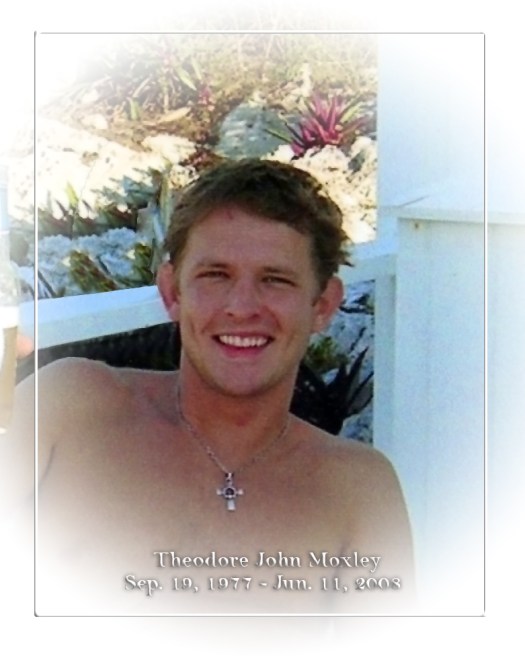
Tod portrait
Portrait of Tod Moxley

You left too soon. I will miss you always. You did not just rip a hole in my heart. You changed the landscape of my life like the eruption of a volcano that alters the land forever. And yes, it burns just as much.

The part of me that understands you dying is human. You were always in pain, and no one knew. They saw the charismatic young man with the attractive dimpled smile. They laughed at the jokes of a man who coped with life’s tragedies with humor. They admired the person who lived on the edge whether it was surfing on the ocean or defying social mores through the company you kept. Your friends were gay, black and white, male and female, rich and poor, long before society accepted people who were different. You drew no class distinctions, and in many ways, you were a true Renaissance Man. You were so much fun that others sought out your company and loved you, and your only distractors were those who envied you or expected someone with so many gifts to accomplish so much more. It was not enough that you simply wanted to enjoy your life and the people in it. Unfortunately, your detractors were those whom you most loved; those whose approval you most needed.

The part of me that does not understand you taking your own life is your mother. I loved you so deeply and needed you in my life. I needed your love. I needed your laughter. I needed those many times when you took a walk along the beach and called me for no reason other than to tell me that you loved me. I needed the long talks we had about everything; about nothing in particular. I regret that despite the many times that I told you that I loved you, you feared that you were a disappointment to me. You were not successful like your brother. You gave me no grandchildren. I think that last hurt you most of all. Yes, it was a disappointment, but I took it in stride. You were living the life you chose; the one that made you happy.

How did your death change the landscape of my life? It impacted nearly every relationship with my friends and family members. Many blamed me. Had I been a good mother you could not have committed suicide.  It mattered not that you were thirty years old, married and living miles away. I don’t know why I keep the letters from family and friends who cruelly spelled out why your death was my fault; that I did not love you enough or cared too little. They shut me out of their lives when I most needed the words from those who loved you to sustain me.

One of the unintended consequences of your death was the estrangement from your brother. His wife disdains me, and he has not called me once in many years to simply say, “Hello Mom.” They call you my “Golden Boy.” They tell me that I was a terrible mother who deserves no respect or affection from them. While you were alive, they were not like this. We visited. We exchanged warm phone calls. That is how the volcano of your loss separated me from him as well. Not surprising. Traumatic events tear apart many families. I am left with mountains of smoking lava separating me from those whom I most love and need.

June 11, 2018, marks ten years since you were gone. I miss you, son! I miss your love and your laughter. I miss you and will love you always.

I Weep For America

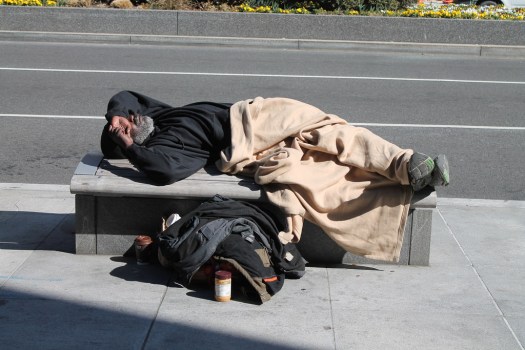
homelessnessPolitics has become an important part of my everyday life. I think that it is more than simply a function of age. I truly fear and despise Trump, his administration and the current political scene wherein Republicans/conservatives hold all three branches of government and refuse to reign in corruption. I believe that Trump may be more corrupt than Warren G. Harding whose policies were the precursor to the Great Depression.

Many of the regulations to protect our air and water have been wiped off the books and corporations are no longer obligated to pay to clean up when they pollute our water. We have abandoned the Paris Climate accord and now produce more waste than any other nation on earth.

Oh, the stock market is doing great, but 10% of Americans own 90% of the market so that is no help to the average citizen. Poverty is worsening. Over half a million people are homeless and this administration is pulling all of the safety nets out from under the poor. *

The cost of a college education has skyrocketed and programs that help students achieve a college education have been slashed. Without an education, there is no upward social mobility. I sincerely worry for my grandchildren. The middle class is shrinking while the number of poor increase, and many of our policies are cruel and inhumane- like separating the children of illegal immigrants from their parents when they cross our borders.

The cost of health care is shameful, and millions of Americans cannot afford health insurance and go without medical care. This is making America great? What is wrong with people that they do not see the destruction we are wreaking?

I weep for the country I love.


*Note: By some estimates, nearly four million people are homeless, but this figure includes those temporarily homeless due to evictions,  etc.

Government as Business

government

Business is the activity of making one’s living or making money by producing or buying and selling goods or services. Simply put, it is any activity or enterprise entered into for profit.

Government is authoritative direction or control and the complex of political institutions, laws and customs through which the function of governing is carried out. There is more within the Miriam-Webster definition similar in meaning, none of which end in “entered into for profit.”

Our government is not a business and was never meant to profit. In fact, the Preamble to the Constitution reads, “We the People of the United States, in order to… establish Justice, insure domestic Tranquility, provide for the common defense, promote the general Welfare, and secure the Blessings of Liberty to ourselves and our Posterity….”

At Gettysburg, Lincoln redefined the Civil War as a struggle not just for the Union, but also for the principle of human equality with his words, “…that this nation, under God, shall have a new birth of freedom — and that government of the people, by the people, for the people, shall not perish from the earth.”  Government should promote the general welfare of all persons equally, and promoting the general welfare comes at a cost.

Our social and economic policies remained a backdrop of  government and did not come to the forefront until Warren G. Harding. Harding promoted pro-business and anti-immigration policies, and enacted deep tax cuts for big business and the wealthy. (Sound familiar?) When Harding died in office, Calvin Coolidge inherited his scandal-ridden office during a period of pronounced materialism and excess. Coolidge succeeded in ridding the administration of corruption, but his economic policies did little to boost the economy or alleviate the suffering of the average citizens. The tax increase that he introduced in 1929 was too late to avert the crash of the stock market, which at the start of Herbert Hoover’s administration, culminated in the Great Depression .

Hoover’s nationalistic policies only worsened the Great Depression. He was unable to lessen the severity and suffering of millions Americans. That took Franklin D. Roosevelt’s New Deal spelled out by the three basic principles of relief, recovery and reform through programs designed to create jobs and most importantly, renew hope. Some of these programs included the Works Progress Administration, the Social Security Administration, and aid to farmers and migrant workers.

While Roosevelt’s programs were successful, poverty continued to impact large swaths of our citizens and slowed the growth of our national economy. The greatest and most far-reaching achievements in improving the lives of American citizens and boosting the economy came thirty years later with the introduction of Lyndon B. Johnson’s “War on Poverty,” seen as a continuation of Roosevelt’s New Deal. The legacy of the War on Poverty policy initiative continues to exist through such federal programs as Head Start, Volunteers in Service to America (VISTA), TRiO (eight education programs administered through the Department of Education), and Job Corps. Other programs include Medicaid and Medicare.

While critics pointed at the growing number social welfare policies and safety net programs and labelled America a “welfare state,” what could not be denied was the overall improvement in the quality of life for millions of Americans and the improvements in the national economy as measured by the growth domestic product (GDP).  Over the years, social and political events created fluctuations in the GDP growth rate but placing the welfare of citizens first has always worked best for our people, our economy and our nation.

The current economic policies under Donald Trump echo Harding’s years in office. Once again, we witness pro-business and anti-immigration policies, and deep tax cuts for big business and the wealthy. Other similarities to Harding’s administration are the evidences of materialism, excess and the extreme corruption of our politicians. The deficits are made up eliminating some of the social welfare policies created to protect the poorest and most vulnerable Americans, and through deep cuts into other programs that serve as a safety net to millions of citizens.

How do we as American citizens remind our politicians that our nation is a government of the people, by the people and for the people and not a business? Government should serve the people, not corporations or the wealthy. We have become a plutocracy instead of a democracy. We buy into the business model of government even though the two words don’t belong together in the same sentence.

Barrack Obama guided our nation out of the 2008 Financial Crisis but most of the safe-guards put into place to prevent another from occurring have been lifted. The disparity in wealth is increasing while the middle class is shrinking. If history bears out, get ready for a crash bigger than the Great Depression.  We should pray for another Franklin Roosevelt or Lyndon B. Johnson although that may not be enough. If we cannot learn from what happened ten years ago, how can we take to heart the lessons of nearly 90 years past?


Note: Homelessness is on the rise for the first time since 2010.  In 2017, nearly 554,00 people were homeless. Of those, over 184,00 were families with children and over 40,000 were veterans. In 2017, ‘Feeding America’ network reported, “41 million Americans struggle with hunger, a number nearly equal to the 40.6 million officially living in poverty.” This administration believes that despite these statistics, cutting social safety net programs will improve our national economy and that these cuts are necessary and reflect good business practices.


A New Generation Gives Us Hopes

The 1960-70s were years of protest. Like now, most of the protestors were America’s youth. Nixon was president 1969-1974. We believed the government was corrupt and labeled it “The Establishment” long before Nixon was sworn in, and after his inauguration we thought our government had moved from bad to worse.

Before Nixon, we protested for civil rights and racial equality during the Kennedy/Johnson years. These rights were hard-won and protestors were often killed by either police or lynch mobs. Even the movement’s leader, Martin Luther King Jr., was gunned down, but we persevered. I remember being suspended from school for a few days for dancing with a black football player at a homecoming dance. Supporting racial equality was not popular and “The Establishment” lashed back. Ultimately, the laws changed. It took a while longer for hearts and heads to catch up.

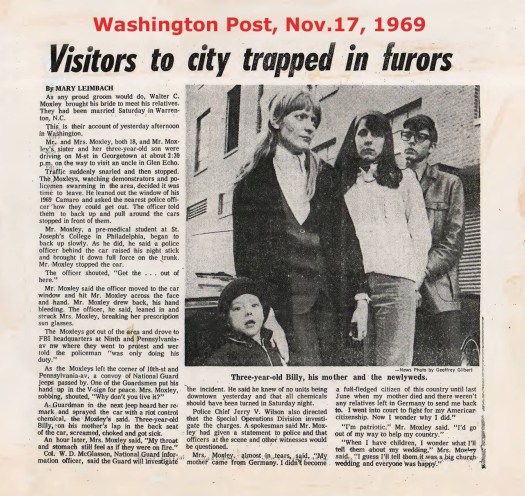
We protested the war in Viet Nam, which in 1969 was the largest protest in Washington D.C. until recent years. It was not easy and certainly not bloodless. The National Guard fired upon protestors at Kent State killing four students. Protestors were labelled radicals and extremists. I participated in many anti-war demonstrations in Philadelphia, yet strangely enough, made newspaper headlines along with my new husband and his sister the day after the 1969 rally in Washington, D.C., when we were caught in traffic. We were not part of the protest and yet were struck by police. A Washington Post reporter photographed us and wrote an article about us that headlined the paper the next day. (I must admit to being a bit melodramatic and a tad less than honest- not about what happened, but about my citizenship.)

At any rate, our protests were heard. The war in Viet Nam ended and Nixon resigned. Nixon was a crook, make no mistake about that!

We protested for women’s rights. We burned bras to signify our wish for freedom. Why? Women of today do not realize what was at stake or what freedoms they are so willing to give up. Women were beholden to their husbands to the degree that they could not get a credit card without their husband’s expressed and written consent. In 1972 the Equal Rights Amendment was passed and sent to the states for ratification.

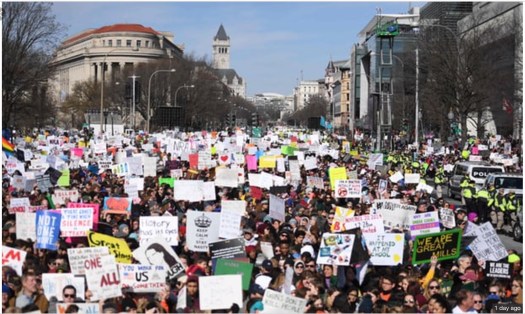
Protests do work! That is why I am so proud of this generation of students willing to take up the challenge and protest for legislative changes. I also hope Donald Trump is paying attention. In their youthful idealism, young voters are less likely to tolerate the corruption to which our Congress has turned a blind eye. Their days are numbered.

nyti.ms/2GdYyUO

Dark Days

I spend too much time reading news and posts on Facebook and too little time expressing my feelings and thoughts. Once in a while, I express myself on Facebook like this post:

“Although I am a Democrat, I thought it stunk of partisanship that disregarded the welfare of citizens when Clinton’s impeachment ended in acquittal. I loved Bill Clinton but knew in my heart that he 1.) lied to Congress and 2.) was guilty of obstruction of justice in the allegations of sexual misconduct against him. I loved him dearly- as much as I loved Al Franken but thought Clinton should have resigned just as Franken did for far less offensive behavior.

“We are now faced with a president who lies incessantly and attempts to obstruct justice at every turn- and that is without considering his long history of alleged sexual misconduct. This is about so much more than fondling and receiving sexual favors. This is about a foreign power attempting to undermine our democratic process. This is a matter of national security and our president prefers to call it a hoax and do nothing to protect our nation. Even his hand-picked National Security Advisor told Congress that the president has not directed or authorized strong countermeasures to Russia’s interference since our 2016 election. Trump has gone so far as to refuse to implement the sanctions voted upon by Congress in unprecedented bipartisan support.

“Will we as Americans allow this to continue? What can we do? What are we willing to do? 1.) Call your elected leaders in both the House and Senate and demand that they confront Trump over his refusal to impose sanctions. 2.) Register to vote and go to the polls this November to vote the GOP out of office.

“The only thing necessary for the triumph of evil is for good men to do nothing.”― Edmund Burke”

These are dark days. Special Counsel Robert Mueller is investigating possible collusion between Trump’s campaign committee and to determine if Trump attempted to obstruct justice by interfering in the investigation. Over forty appointed national officers including cabinet secretaries have been let go and nearly every federal prosecutor. He appointed federal judges with zero trial experience and secretaries that have long histories of litigating against the departments they now lead. Our nationally protected lands have been slashed and opened to mining and development. Measures enacted to preserve our environment are gone as are the laws protecting consumers from corporate greed.

Last night, Jeff Sessions, Attorney General, fired Andrew McCabe, former director of the FBI. He was fired at 10 p.m. Friday, within 48 hours of retiring, both to deny him his pension and to discredit him as a witness against Trump. Trump repeatedly called for his firing so how is it not political?

As of today, there have been 63 mass shootings including one in a south Florida high school that left 17 teens dead. The survivors are busy campaigning for reasonable gun legislation. God bless them! Maybe they will be the generation that saves us from ourselves.

Today is St. Patrick’s Day, a day that always makes me think about my son, Tod. He always celebrated this day.

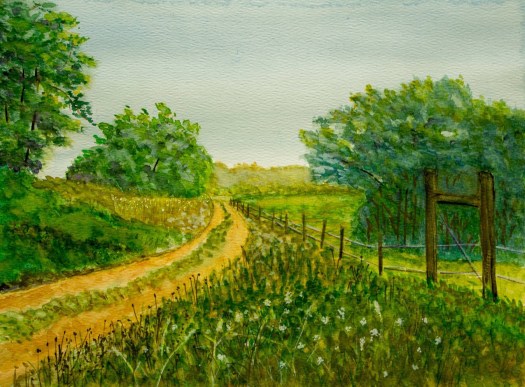
Not everything is dark and foreboding. I am painting again. I am determined to learn how to watercolor. Most pieces are mediocre at best but a few came out decent.

LET’S HAVE THE RIGHT CONVERSATION

sex-harass

No one needs the avalanche of news reports about sexual harassment and sexual assault to know that it is very real and that it happens every day, everywhere. It happens in schools, in the workplace, in churches, in social situations, and sadly for many, even at home. Is there a single adult in the room who did not know that sexual misconduct is rampant?  The endless charges against public figures expose our hypocrisy and complicity.  We knew, but before now, we turned a blind eye. Let’s not have this conversation when another is more relevant and productive. We must define appropriate behavior for both men and women as well as what constitutes sexual assault.

Rape is easy to define.  NO means NO and any inability to say YES (such as not being of the age of consent, inebriation or a position of power of one person over another) means NO. Other forms of sexual misconduct may not be as clear. When does flirtation become sexual assault? Does all touch beyond a handshake require consent? Can there be implied consent between adults? What about a pat on the back or a hug between friends or coworkers?) Are the rules for men and women the same? What about teens? Thanks to mother nature, it does not require much to give a young man an erection.

Sexual harassment dictates that when ‘A’ is uncomfortable with the behavior of ‘B’ (behavior not deliberately aimed at ‘A’), ‘A’ has a responsibility first to voice their discomfort. Only when ‘B’ ignores ‘A’s’ objection does it rise to the level of a sexual harassment complaint requiring administrative action. We must define what constitutes sexual misconduct and do so very quickly before the lives of many good men are destroyed.

Why would I, a survivor of gross sexual assault and debilitating sexual harassment say this? Because sexual misconduct is real and must be dealt with dispassionately. We must do this if not to avoid, then to reduce the number of sexual misconduct allegation becoming weaponized.

Too many women falsely allege that their spouse committed sexual abuse in child custody cases, and thousands of more women seek temporary restraining orders based upon false allegations. The upshot is that fewer allegations of incest and physical abuse are believed, meaning fewer women and children receive the protections they need. In the same vein, unsupported allegations of sexual misconduct will diminish their validity. One cannot solve a problem not deemed valid.

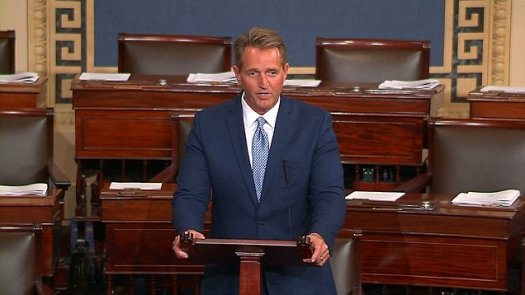
Senator Jeff Flake (R) Arizona Resigns

Jeff Flake (R) Arizona

It would appear that I am not alone in my sense of dread and despair over the direction our government is taking. Today, Jeff Flake, a conservative Republican senator from Arizona resigned. This is the resignation speech he delivered to the Senate with the president in attendance.  Like me, he wonders what kind of world we leave our children and grandchildren.

Mr. President, I rise today to address a matter that has been much on my mind, at a moment when it seems that our democracy is more defined by our discord and our dysfunction than it is by our values and our principles.  Let me begin by noting a somewhat obvious point that these offices that we hold are not ours to hold indefinitely.  We are not here simply to mark time. Sustained incumbency is certainly not the point of seeking office. And there are times when we must risk our careers in favor of our principles.

Now is such a time.

It must also be said that I rise today with no small measure of regret. Regret, because of the state of our disunion, regret because of the disrepair and destructiveness of our politics, regret because of the indecency of our discourse, regret because of the coarseness of our leadership, regret for the compromise of our moral authority, and by our – all of our – complicity in this alarming and dangerous state of affairs. It is time for our complicity and our accommodation of the unacceptable to end.

In this century, a new phrase has entered the language to describe the accommodation of a new and undesirable order – that phrase being “the new normal.” But we must never adjust to the present coarseness of our national dialogue – with the tone set at the top.

We must never regard as “normal” the regular and casual undermining of our democratic norms and ideals. We must never meekly accept the daily sundering of our country – the personal attacks, the threats against principles, freedoms, and institutions, the flagrant disregard for truth or decency, the reckless provocations, most often for the pettiest and most personal reasons, reasons having nothing whatsoever to do with the fortunes of the people that we have all been elected to serve.

None of these appalling features of our current politics should ever be regarded as normal. We must never allow ourselves to lapse into thinking that this is just the way things are now. If we simply become inured to this condition, thinking that this is just politics as usual, then heaven help us. Without fear of the consequences, and without consideration of the rules of what is politically safe or palatable, we must stop pretending that the degradation of our politics and the conduct of some in our executive branch are normal. They are not normal.

Reckless, outrageous, and undignified behavior has become excused and countenanced as “telling it like it is,” when it is actually just reckless, outrageous, and undignified.

And when such behavior emanates from the top of our government, it is something else: It is dangerous to a democracy. Such behavior does not project strength – because our strength comes from our values. It instead projects a corruption of the spirit, and weakness.

It is often said that children are watching. Well, they are. And what are we going to do about that?

When the next generation asks us, Why didn’t you do something? Why didn’t you speak up? — what are we going to say?

Mr. President, I rise today to say: Enough. We must dedicate ourselves to making sure that the anomalous never becomes normal. With respect and humility, I must say that we have fooled ourselves for long enough that a pivot to governing is right around the corner, a return to civility and stability right behind it. We know better than that. By now, we all know better than that.

Here, today, I stand to say that we would better serve the country and better fulfill our obligations under the constitution by adhering to our Article 1 “old normal” – Mr. Madison’s doctrine of the separation of powers. This genius innovation which affirms Madison’s status as a true visionary and for which Madison argued in Federalist 51 – held that the equal branches of our government would balance and counteract each other when necessary. “Ambition counteracts ambition,” he wrote.

But what happens if ambition fails to counteract ambition? What happens if stability fails to assert itself in the face of chaos and instability? If decency fails to call out indecency? Were the shoe on the other foot, would we Republicans meekly accept such behavior on display from dominant Democrats? Of course not, and we would be wrong if we did.

When we remain silent and fail to act when we know that that silence and inaction is the wrong thing to do – because of political considerations, because we might make enemies, because we might alienate the base, because we might provoke a primary challenge, because ad infinitum, ad nauseam – when we succumb to those considerations in spite of what should be greater considerations and imperatives in defense of the institutions of our liberty, then we dishonor our principles and forsake our obligations. Those things are far more important than politics.

Now, I am aware that more politically savvy people than I caution against such talk. I am aware that a segment of my party believes that anything short of complete and unquestioning loyalty to a president who belongs to my party is unacceptable and suspect.

If I have been critical, it not because I relish criticizing the behavior of the president of the United States.  If I have been critical, it is because I believe that it is my obligation to do so, as a matter of duty and conscience. The notion that one should stay silent as the norms and values that keep America strong are undermined and as the alliances and agreements that ensure the stability of the entire world are routinely threatened by the level of thought that goes into 140 characters – the notion that one should say and do nothing in the face of such mercurial behavior is ahistoric and, I believe, profoundly misguided.

A Republican president named Roosevelt had this to say about the president and a citizen’s relationship to the office:

“The President is merely the most important among a large number of public servants. He should be supported or opposed exactly to the degree which is warranted by his good conduct or bad conduct, his efficiency or inefficiency in rendering loyal, able, and disinterested service to the nation as a whole. Therefore, it is absolutely necessary that there should be full liberty to tell the truth about his acts, and this means that it is exactly as necessary to blame him when he does wrong as to praise him when he does right. Any other attitude in an American citizen is both base and servile.”  President Roosevelt continued. “To announce that there must be no criticism of the President, or that we are to stand by the President, right or wrong, is not only unpatriotic and servile, but is morally treasonable to the American public.”

Acting on conscience and principle is the manner in which we express our moral selves, and as such, loyalty to conscience and principle should supersede loyalty to any man or party. We can all be forgiven for failing in that measure from time to time. I certainly put myself at the top of the list of those who fall short in that regard. I am holier-than-none. But too often, we rush not to salvage principle but to forgive and excuse our failures so that we might accommodate them and go right on failing-until the accommodation itself becomes our principle.

In that way and over time, we can justify almost any behavior and sacrifice almost any principle. I’m afraid that is where we now find ourselves. When a leader correctly identifies real hurt and insecurity in our country and instead of addressing it goes looking for somebody to blame, there is perhaps nothing more devastating to a pluralistic society. Leadership knows that most often a good place to start in assigning blame is to first look somewhat closer to home. Leadership knows where the buck stops. Humility helps. Character counts. Leadership does not knowingly encourage or feed ugly and debased appetites in us.

Leadership lives by the American creed: E Pluribus Unum. From many, one. American leadership looks to the world, and just as Lincoln did, sees the family of man. Humanity is not a zero-sum game. When we have been at our most prosperous, we have also been at our most principled. And when we do well, the rest of the world also does well.

These articles of civic faith have been central to the American identity for as long as we have all been alive. They are our birthright and our obligation. We must guard them jealously, and pass them on for as long as the calendar has days. To betray them, or to be unserious in their defense is a betrayal of the fundamental obligations of American leadership.  And to behave as if they don’t matter is simply not who we are.

Now, the efficacy of American leadership around the globe has come into question. When the United States emerged from World War II we contributed about half of the world’s economic activity. 

It would have been easy to secure our dominance, keeping the countries that had been defeated or greatly weakened during the war in their place.  We didn’t do that.  It would have been easy to focus inward.  We resisted those impulses.  Instead, we financed reconstruction of shattered countries and created international organizations and institutions that have helped provide security and foster prosperity around the world for more than 70 years.

Now, it seems that we, the architects of this visionary rules-based world order that has brought so much freedom and prosperity, are the ones most eager to abandon it.

The implications of this abandonment are profound. And the beneficiaries of this rather radical departure in the American approach to the world are the ideological enemies of our values. Despotism loves a vacuum.  And our allies are now looking elsewhere for leadership. Why are they doing this? None of this is normal. And what do we as United States Senators have to say about it?

The principles that underlie our politics, the values of our founding, are too vital to our identity and to our survival to allow them to be compromised by the requirements of politics. Because politics can make us silent when we should speak, and silence can equal complicity.

I have children and grandchildren to answer to, and so, Mr. President, I will not be complicit.

I have decided that I will be better able to represent the people of Arizona and to better serve my country and my conscience by freeing myself from the political considerations that consume far too much bandwidth and would cause me to compromise far too many principles.

To that end, I am announcing today that my service in the Senate will conclude at the end of my term in early January 2019.

It is clear at this moment that a traditional conservative who believes in limited government and free markets, who is devoted to free trade, and who is pro-immigration, has a narrower and narrower path to nomination in the Republican party – the party that for so long has defined itself by belief in those things.  It is also clear to me for the moment we have given in or given up on those core principles in favor of the more viscerally satisfying anger and resentment.  To be clear, the anger and resentment that the people feel at the royal mess we have created are justified.  But anger and resentment are not a governing philosophy.

There is an undeniable potency to a populist appeal – but mischaracterizing or misunderstanding our problems and giving in to the impulse to scapegoat and belittle threatens to turn us into a fearful, backward-looking people. In the case of the Republican party, those things also threaten to turn us into a fearful, backward-looking minority party.

We were not made great as a country by indulging or even exalting our worst impulses, turning against ourselves, glorying in the things which divide us, and calling fake things true and true things fake. And we did not become the beacon of freedom in the darkest corners of the world by flouting our institutions and failing to understand just how hard-won and vulnerable they are.

This spell will eventually break. That is my belief. We will return to ourselves once more, and I say the sooner the better. Because to have a healthy government we must have healthy and functioning parties. We must respect each other again in an atmosphere of shared facts and shared values, comity and good faith. We must argue our positions fervently, and never be afraid to compromise. We must assume the best of our fellow man, and always look for the good. Until that day comes, we must be unafraid to stand up and speak out as if our country depends on it. Because it does.

I plan to spend the remaining fourteen months of my senate term doing just that.

Mr. President, the graveyard is full of indispensable men and women — none of us here is indispensable. Nor were even the great figures from history who toiled at these very desks in this very chamber to shape this country that we have inherited. What is indispensable are the values that they consecrated in Philadelphia and in this place, values which have endured and will endure for so long as men and women wish to remain free. What is indispensable is what we do here in defense of those values. A political career doesn’t mean much if we are complicit in undermining those values.

I thank my colleagues for indulging me here today, and will close by borrowing the words of President Lincoln, who knew more about healing enmity and preserving our founding values than any other American who has ever lived. His words from his first inaugural were a prayer in his time, and are no less so in ours:

“We are not enemies, but friends. We must not be enemies. Though passion may have strained, it must not break our bonds of affection. The mystic chords of memory will swell when again touched, as surely they will be, by the better angels of our nature.”

Thank you, Mr. President. I yield the floor. Ω

Hurricane Trump Razes a Nation.

Why do I write about evacuating for Hurricane Irma and never mention the devastation caused by Hurricane Maria? Why do I avoid writing about my day to day life and the current sociopolitical climate? It is ugly. I will first tackle the second question because it leads to the answer to my first question.

I will never forget my sense of disbelief and despair on November 8, 2016, when the electoral college elected Donald Trump (R) over Hillary Clinton (D).  How was it possible? Clinton won by more than three million of the popular vote. Donald Trump, an American billionaire, had never held any political office. He was rude, crude and held openly racist views and bragged about sexually assaulting women and getting away with it. Married three times, the Christian right hailed him as their champion because he opposed abortion and was a strong supporter of gun rights. Since his election, he has voiced his support for Russia and Vladimir Putin while insulting American heroes and attacking the free press on a daily basis.

Since his inauguration, we have moved from one scandal to the next and from one crisis to another. I feel like a reverberating bell.  When I have not yet stopped reverberating from the clang of something as racist as an immigration ban on Muslims, there comes another scandal, like the Environmental Protection Agency stripping away clean air and water regulations, and Trump’s numerous attempts to repeal the American Healthcare Act and scaling back Social Security and Medicare benefits. His administration is trying to privatize the American education system and laid bare the school lunch program and other programs to feed the poor.

Charlottesville
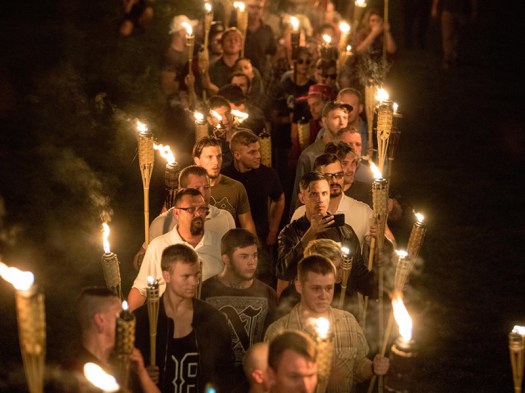
Chanting, “White lives matter!” “You will not replace us!” and “Jews will not replace us!” several hundred white nationalists and white supremacists marched Friday as part of a Unite the Right rally at the University of Virginia that resulted in violence and three deaths the next day. (Photo by Evelyn Hockstein for The Washington Post)

Trump has attacked everything except the rights of multi-billion dollar corporations. He refused to endorse the Paris Climate Accord leaving us and Syria the only two nations that have not endorsed this world-wide effort to clean up the earth, and not ratified previously negotiated trade agreements because they are according to him, not fair to Americans. The most important issue is an investigation by the Justice Department and similar weak attempts by the Senate and House into possible collusion with Russia to throw the election. Russia hacked the Democratic National Committee and several states’ voting systems. We do not yet know the extent of the damage. I don’t even recognize my country anymore. Can this really be the U.S.A.?  Worse yet, Trump is recklessly courting a war with North Korea. That cannot end well for millions in both North and South Korea, Japan and China… and the United States.

Enter Hurricane Maria. In August, Hurricane Harvey, a category two storm struck Houston. The damage was unimaginable.  A month later, Hurricane Irma struck Florida, and less than two weeks later, Hurricane Maria, a category five storm struck Puerto Rico and the U.S. Virgin Island and devastated those islands. It left little standing in its wake. More than a month later, less than 20% of Puerto Rico residents have electric or clean water.

puerto-rico-hurricane-maria-aftermath1
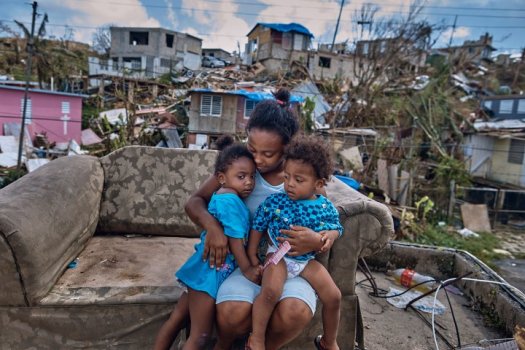
A family sits on a sodden couch were once stood their home. Photo by Andres Kudacki for TIME

How did Trump respond? Within three days he visited Houston and committed every possible resource to rebuild the area. He responded just as quickly to Florida after Irma, but while Maria was wiping out Puerto Rico and for the days after, Trump played golf at one of his resorts and tweeted incessantly against NFL players who kneeled rather than stood for the national anthem. Kneeling was in protest of the thousands of black men who die every year at the hands of law enforcement officers who are rarely held accountable. In too many instances, these black men were unarmed or shot in the back. Trump, however, is racist. It maddened him that these players dared to ‘disrespect’ the American flag.

Back to Puerto Rico. When Trump did finally tweet about Puerto Rico, he mentioned the territory’s massive debts and how bad their infrastructure was before the storm.  It took him three weeks to visit Puerto Rico to offer his support for its residents. It got uglier from there as he launched a personal attack against San Juan’s mayor. Puerto Rico is still a mess, and the newest scandal/crisis is four soldiers died in Niger earlier this month, and Trump and the Secretary of State insulted the wife of the only black soldier who died on that mission.

Trump is devastating the American sociopolitical landscape as surely as the hurricanes destroyed our soil. He is dividing the Republican Party and turning it into something not recognizable anymore. There are no more moderates. Republicans have moved to the extreme right, and any legislator who speaks or votes against them is labeled unpatriotic and un-American. When he campaigned, it was on the promise that he would change Washington forever. He is succeeding. I cannot help but wonder what will become of decent Republicans with a social conscience. I think Hurricane Trump has effectively annihilated them, at least for today. Will I live long enough to see the party regain its senses and recover from this? Ω

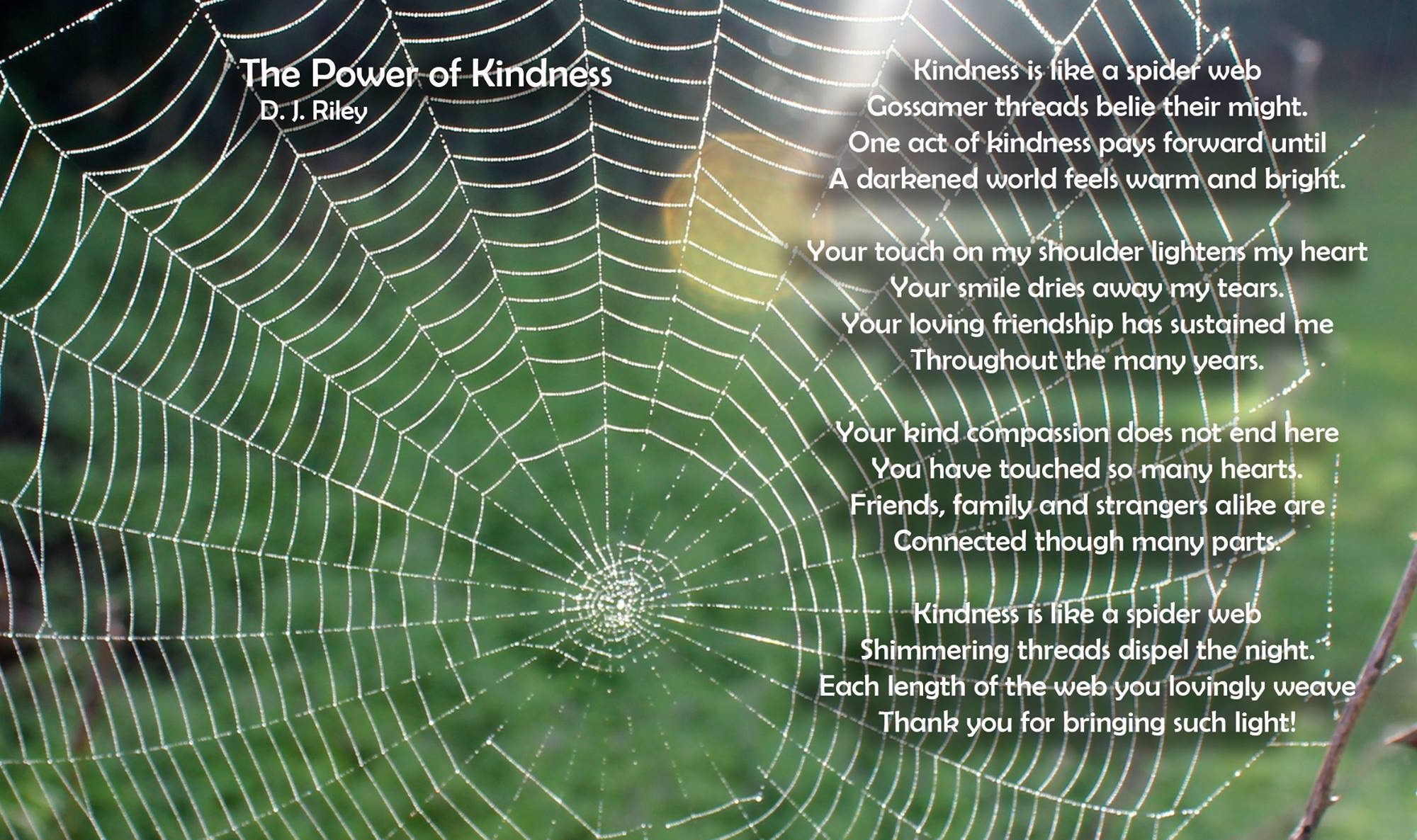
The Power of Kindness

Kindness is like a spider web
Gossamer threads belie their might.
One act of kindness pays forward until
A darkened world feels warm and bright.

Your touch on my shoulder lightens my heart
Your smile dries away my tears.
Your loving friendship has sustained me
Throughout the many years.

Your kind compassion does not end here
You have touched so many hearts.
Friends, family and strangers alike are
Connected through many parts.

Kindness is like a spider web
Shimmering threads dispel the night.
Each length of the web you lovingly weave
Thank you for bringing such light!