
Inner-city Violence

09_Legends South

Recently, I saw a meme about the 72 people shot in Chicago. I cannot quote it verbatim, but it said that they were not brown people trying to cross the border illegally; that they were black American citizens in Chicago so LIBERALS can go back to not caring.

While the entire point of the meme was to besmirch Democrats/liberals, what struck me was how something as terrible as inner-city violence was used not to express outrage over conditions within big cities or compassion for those who lost a son, a brother or father during that bloody weekend, but only as an attack on ‘liberals!’  As a social worker, I worked in inner cities, and I have some understanding of how people living in these pockets of poverty perceive the world around them and how they feel.

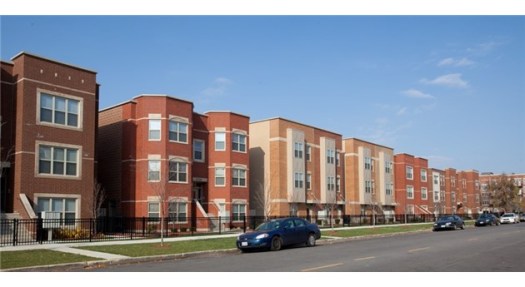
Chicago has the third largest public housing agency in the country. They have come a long way toward removing the huge apartment complexes that housed hundreds of families to invest in two and three unit buildings. Building smaller units has dropped the people to space ration from 75-90 persons per acre to 40-50 persons. An acre as a unit of measure may sound vague, and as offering a point of reference, a square acre measures 208.7 feet x 208.7 feet, or at 50 people per acre, each person has the equivalent of a little more than four feet of living space!

Housing units go on for blocks and stores, and other businesses are rarely located nearby. Residents of these Chicago neighborhoods have fewer privately owned vehicles, but the city has a great public transit network. Can you imagine bringing home a week’s worth- let alone a month’s worth of groceries on a bus? People less likely able to afford it are forced to pay friends, taxis, and ubers for rides to shop for necessities like food or school clothing or to keep medical appointments.

People unfamiliar with these populations erroneously assume that these families subsist solely on welfare. Most of the heads of households are employed albeit at minimum wage or low-paying jobs. The reduced wage makes them eligible for housing assistance, and many families cannot get by without subsidized daycare, Food Stamps, S.N.A.P., government-subsidized health insurance programs like CHIP and other safety net programs. Families that subsist on Aid to Dependent Children programs are worse off.

Education is the path out of dire poverty, and Chicago prides itself in a public school system that takes advantage of every resource possible from hiring good teachers, offering various after-school programs, day trips to expose inner-city children to other cultures and experiences, and to a social media campaign. What competes against all of their efforts is innercity gangs.  What gives the gangs such a strong grip on Chicago residents?

Living conditions are comprised of physical and emotional space, and the absence of hope dominates the emotional space. They have nothing to look forward to, and their living conditions are not likely to improve. Drugs, guns, and gangs rule the streets. These communities have troubled relationships with Chicago P.D. They see police commit violence against minorities and witness black men killed at an increasing rate.  They feel marginalized by the rest of society and fear that their voices are not heard. They are often degraded and shamed by employees of the agencies they need most to survive and are treated like welchers. They face an endless cycle of poverty, feel hopeless and helpless, and that sense of helplessness is what encourages young men to join gangs. Gangs represent a form of power.

Gang wars are about turf. Gangs encroach on each other’s neighborhoods or “turf” to extend their power and to increase revenues. That gang retaliates by killing their invaders, and the invaders retaliate by killing more of their rivals creating an endless cycle of killings.

We cannot impact inner-city murder rates without changing the environment. We must first restore hope and opportunities.  The Trump administration is cutting desperately needed aid such as housing assistance, CHIP, food stamps, etc., which will only make living conditions direr and increase the helplessness that drives young people into a life of crime. Restore assistance to working low-income families and create opportunities to escape the cycle of violence. That will do more to curb violence than calling out the National Guard.  Ω
Journalists Matter!

When talking about news reports, as soon as people start to throw out phrases like “fake news,” liberal brainwashing,” liberal media manipulation,” I suspect that the person knows nothing about journalism, journalism education, news reporting or news ethics. It is akin to calling doctors shamans because one does not understand the extent of medical training doctors receive or the Hippocratic oath that they take. The misconceptions in news reporting may in part be to the rise in television news commentators, most of whom are TV personalities and not trained journalists, not understanding the difference between news and opinion articles, and a president who denigrates journalists at every opportunity and calls them “the enemy of the people.” Trump, however, has both an agenda and a lack of understanding about the field.

Journalists are trained carefully in every genre published in newspapers and periodicals. A news article has specific criteria for both structure and content, and it must be factual and backed up by documents or reputable sources. (Donald Trump knows this well because he has in the past sued major newspapers for publishing what he alleged were false statements about him.) When newspapers publish incorrect facts, they either follow up with retractions or corrections.

Newspapers also print opinion pieces. Most newspapers place opinion pieces in a separate section. In some cases, the author’s name indicates it is an opinion piece as many of their authors are regular columnists.

Television news commentators are separate from printed news sources. While many commentators are trained journalists, personalities who host daily shows on news networks often offer more opinion than facts while local nightly news broadcasts usually lean more towards facts.

Code of Ethis
Society of Professional Journalists Code of Ethics

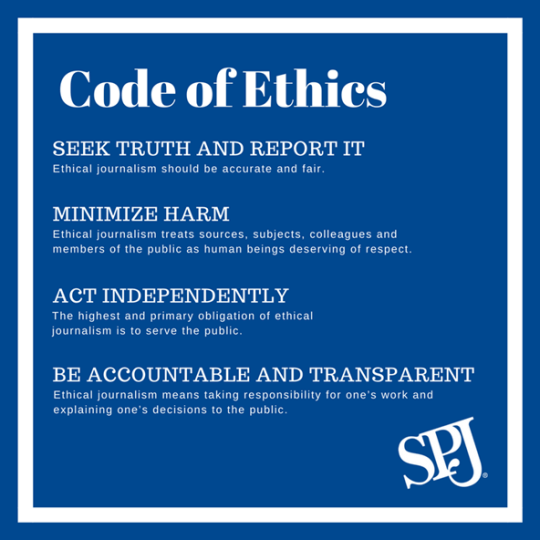
Journalists do not take a Hippocratic oath, but they are professionals guided by a code of ethics. The preamble states: “Members of the Society of Professional Journalists believe that public enlightenment is the forerunner of justice and the foundation of democracy. Ethical journalism strives to ensure the free exchange of information that is accurate, fair and thorough. An ethical journalist acts with integrity.

The Society declares these four principles as the foundation of ethical journalism and encourages their use in its practice by all people in all media: 1.) Seek Truth and Report It, 2.) Minimize Harm, 3.) Act Independently, and 4.)  Be Accountable and Transparent.”

You can find the Code of Ethics of the Society of Professional Journalism here: https://www.spj.org/ethicscode.asp

Stop denigrating journalists. Learn what it is that they do and why they do it. In 2017 alone, their commitment to truth caused over seventy journalists to be murdered or killed worldwide while reporting, covering an incident, or because of their status as a journalist. Journalists deserve better. They truly are the guardians of our democracy.

List of journalists killed in 2017: https://en.wikipedia.org/wiki/List_of_journalists_killed_in_2017

Note: I am not a journalist. I am a citizen who appreciates honest reporting.

A Different Path to Education

USF

I earned a Masters in Social Work from the University of South Florida in 1980. It was a dream come true for a girl from the projects of Newport, Kentucky. How this came about is this story.

I grew up poor, and after the age of 12, was a ward of the state and spent my teenage years in foster homes and institutions. That should be singular. I was in one institution, Our Lady of the Highlands in Fort Thomas, Kentucky, which preceded two failed foster care placements.

The second foster family sent me to live with my father, the man who had sexually abused me as a little girl. Yes, they knew what he had done, but they said he was a Christian now and that God had forgiven him. Although I knew he would never again molest me, it was still stressful. Every day I faced the reminder of what had been, and I held my breath every time he walked past my bedroom door at night.

My oldest sister also lived with him as did my younger sister. My oldest sister had always blamed me for the breakup of our family because I reported the abuse. She was four or five months pregnant and said that she could not work to help support us. My father held a minimum wage job, which in 1968 was $1.60 an hour. She and my father encouraged me to get a job to help with expenses and so that Liz could buy baby clothes and other things for her coming child. I did as expected of me and dropped out of school.

Living with my family did not work out for me, and since I was employed full time, a family court judge gave me custody of myself. After a few months, I moved in with a friend in Pennsylvania and tried going back to school, but again I dropped out. Finally, in 1969 I took the G.E.D. examination and passed.  A high school equivalency was better than no diploma at all.

I will skip past years that included getting married, having a baby, and other life-altering events and jump to my years in the U.S. Army. There, I learned about the DANTE*[1] tests and CLEP*[2] tests and took advantage of them to earn over 90 credits. I also attended classes at one of Park University campuses at Fort Bliss, Texas. When I left the military, I had over 120 credits but no degree.  That meant taking additional courses at St. Joseph’s College in Philadelphia and at West Chester State College in Pennsylvania. Those credits were transferred back to Park University, which awarded me a bachelor’s degree in Social Psychology in 1980.

By then I had two children to support and no financial or any other type of assistance from my sons’ fathers. At least the degree helped me get a better paying job. I got married again, and a few years later, we moved to Florida.

I had no idea what a social worker was until I met one in a nursing home. She told me a little about the field, and I realized that this is what I wanted to do for the rest of my working life. She told me that the University of South Florida had a social work program. It took me another year to apply because I had never taken the SAT. That terrified me. How could I pass the SAT when I never attended regular college courses? I bought books and studied at home for a year, then completed the application for the test and sent in the fee.

The day of the test, I was so anxious that I had panic attacks and could not focus. A voice in my head told me that taking the test was an act of futility. I don’t know how I got through it. When my scores arrived in the mail, I had mixed feelings. I was disappointed that I had scored so low but thrilled that I scored high enough to meet the university’s admission requirements. (Not sure now, but I think I scored 1150. Not impressive.)

I submitted my application to the program just before the deadline for the upcoming school year. I knew that less than 20% of all applicants were accepted and that it would take months after the interview to learn if I had been approved. By the day of the interview, I had so little real hope that I faced my interviewer with the attitude that I had nothing to lose. I must add one other thing. Before the interview, I prayed a lot. I told God that I needed his help but that I had trouble discerning between his will and mine, and that if it was his will that I should be a social worker, that he had to give me a sign, and nothing subtle either. It had to be significant, like handwriting on the wall.

I got my handwriting on the wall. I don’t remember the interview, but I remember how it ended. At the conclusion, my interviewer stuck out his hand to shake mine. Instead of a polite “goodbye” he said, “welcome to the University of South Florida Graduate School of Social Work.” I could not believe what I had heard and asked him to verify that I was in.

I completed the Masters in Social Work with a 3.77 GPA. I could not manage better than a ‘B’ in statistics, and one of my professors downgraded me a full grade, from an ‘A’ to a ‘B’ for missing too many classes. I did not point out to him that I attended school full time, worked 40 hours a week at night, and another 20 hours a week for my internship in addition to having a family. I was too proud. It only mattered that I completed the program and earned my degree. Even with a less than 4.0 GPA, I was in the top 10% of my class. My bachelor’s degree was often scoffed at because I tested out of more courses than I attended, but no one could take this accomplishment away from me. Ω


[1] DSST (formerly DANTES Subject Standardized Tests) are credit-by-examination tests originated by the United States Department of Defense’s Defense Activity for Non-Traditional Education Support (DANTES) program.

[2] The College Board’s College-Level Examination Program (CLEP)