
Inner-city Violence

09_Legends South

Recently, I saw a meme about the 72 people shot in Chicago. I cannot quote it verbatim, but it said that they were not brown people trying to cross the border illegally; that they were black American citizens in Chicago so LIBERALS can go back to not caring.

While the entire point of the meme was to besmirch Democrats/liberals, what struck me was how something as terrible as inner-city violence was used not to express outrage over conditions within big cities or compassion for those who lost a son, a brother or father during that bloody weekend, but only as an attack on ‘liberals!’  As a social worker, I worked in inner cities, and I have some understanding of how people living in these pockets of poverty perceive the world around them and how they feel.

Chicago has the third largest public housing agency in the country. They have come a long way toward removing the huge apartment complexes that housed hundreds of families to invest in two and three unit buildings. Building smaller units has dropped the people to space ration from 75-90 persons per acre to 40-50 persons. An acre as a unit of measure may sound vague, and as offering a point of reference, a square acre measures 208.7 feet x 208.7 feet, or at 50 people per acre, each person has the equivalent of a little more than four feet of living space!

Housing units go on for blocks and stores, and other businesses are rarely located nearby. Residents of these Chicago neighborhoods have fewer privately owned vehicles, but the city has a great public transit network. Can you imagine bringing home a week’s worth- let alone a month’s worth of groceries on a bus? People less likely able to afford it are forced to pay friends, taxis, and ubers for rides to shop for necessities like food or school clothing or to keep medical appointments.

People unfamiliar with these populations erroneously assume that these families subsist solely on welfare. Most of the heads of households are employed albeit at minimum wage or low-paying jobs. The reduced wage makes them eligible for housing assistance, and many families cannot get by without subsidized daycare, Food Stamps, S.N.A.P., government-subsidized health insurance programs like CHIP and other safety net programs. Families that subsist on Aid to Dependent Children programs are worse off.

Education is the path out of dire poverty, and Chicago prides itself in a public school system that takes advantage of every resource possible from hiring good teachers, offering various after-school programs, day trips to expose inner-city children to other cultures and experiences, and to a social media campaign. What competes against all of their efforts is innercity gangs.  What gives the gangs such a strong grip on Chicago residents?

Living conditions are comprised of physical and emotional space, and the absence of hope dominates the emotional space. They have nothing to look forward to, and their living conditions are not likely to improve. Drugs, guns, and gangs rule the streets. These communities have troubled relationships with Chicago P.D. They see police commit violence against minorities and witness black men killed at an increasing rate.  They feel marginalized by the rest of society and fear that their voices are not heard. They are often degraded and shamed by employees of the agencies they need most to survive and are treated like welchers. They face an endless cycle of poverty, feel hopeless and helpless, and that sense of helplessness is what encourages young men to join gangs. Gangs represent a form of power.

Gang wars are about turf. Gangs encroach on each other’s neighborhoods or “turf” to extend their power and to increase revenues. That gang retaliates by killing their invaders, and the invaders retaliate by killing more of their rivals creating an endless cycle of killings.

We cannot impact inner-city murder rates without changing the environment. We must first restore hope and opportunities.  The Trump administration is cutting desperately needed aid such as housing assistance, CHIP, food stamps, etc., which will only make living conditions direr and increase the helplessness that drives young people into a life of crime. Restore assistance to working low-income families and create opportunities to escape the cycle of violence. That will do more to curb violence than calling out the National Guard.  Ω
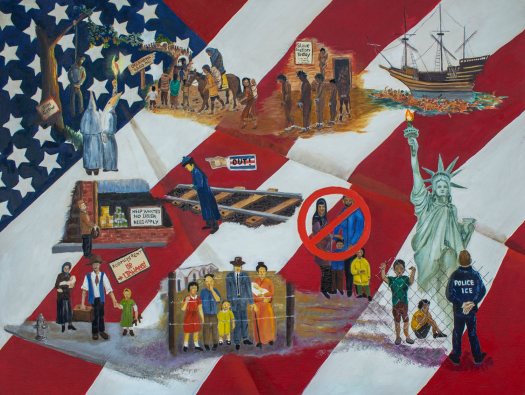
Coming to America

37863169_2224779260869031_5184011430189334528_o
Coming to America, oil on canvas by artist, Dorothy J. Riley

Our history of immigration is checkered, at best. The flood of settlers from Europe at the turn of the 17th Century destroyed thousands of Native Americans and their villages. We then imported thousands of slaves from Africa and other places but they and their American born offspring were not counted as citizens. The remaining Native American peoples were forcibly evicted from the Eastern coast in 1830 by Andrew Jackson and Martin Van Buren to make room for white settlers. The Indian Removal Act is better known as the Trail of Tears.

While the Civil War freed the slaves, African Americans continued to be treated as second class citizens supported by discriminatory policies in education, housing, and voting restrictions. Jim Crow practices served as a constant reminder that white Americans believed African Americans inferior.

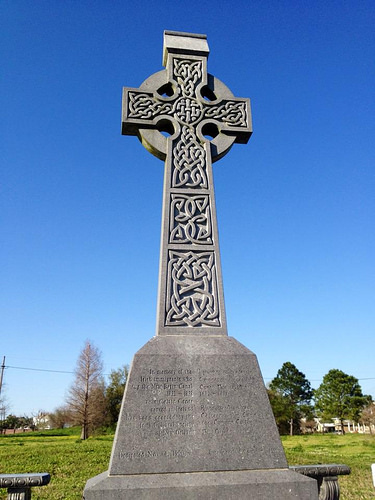
Irish and Italian immigrants were not wanted because they were often poor when they arrived on our shores, but mostly because white Protestant Americans feared the influx of Catholicism. The Irish were in fact, considered less “valuable” than slaves as laborers and were used for constructing the canal in New Orleans were the high rate of death made it too “expensive” to use slave labor. It is estimated that between 8,000-20,000 Irish laborers died building the canal.

Kilkenny cross-NOLA
Kilkenny Cross in New Orleans honoring the thousands of Irish immigrants who died building the canal.

We then imported thousands of Chinese to build the Transcontinental Railway.  (One of my previous posts.) When we no longer needed their labor, we sent them back to China and banned Chinese immigrants.

Our next target were the Japanese during WWII. To quote Wikipedia, “The internment of Japanese Americans in the United States during World War II was the forced relocation and incarceration in camps in the western interior of the country of between 110,000 and 120,000 people of Japanese ancestry, most of whom lived on the Pacific coast.”

Most were U.S. citizens, many were born in the U.S., owned property and businesses, all of which was confiscated by the government.  Many were paid for their lost properties but the compensation was far less than 10% of the actual value. Call it what you may, they were imprisoned for the crime of being Japanese or of Japanese descent.

Two other noteworthy acts of discrimination occurred, both recently under the administration of Donald Trump. The first of these was the “Muslim Ban,” allegedly, to deter terrorists from reaching our country. Trump’s first attempts to ban Muslims were struck down by the courts, but after repeated attempts and by changing the language of the executive order, the last attempt succeeded. Strangely enough, Saudi Arabia was not on the list of banned immigrants despite 15 of the 19 persons who attacked our nation on 9/11 being citizens of that nation!

The most heinous act was the removal of over 2,500 children from South American families seeking asylum in our country. A court overruled the separation of families, but many parents were deported without their children and hundreds of children are waiting to be reunited. Worse, many of the children who were returned had body lice, were dirty, malnourished, were physically and sexually abused and severely traumatized. The photos of these children kept in chain-link cages is what inspired my painting, “Coming to America.”  How could we do that?

Parents Deported Without Their Children.

I wrote a poem about immigration:

Unwanted Immigrants

Riley, O’Malley and O’Shea-
Remember when you were not welcome on these shores?
Ricco, Ferrari and Rizzo-
Remember when to you they closed the doors?

Wan, Wong, Chang and Bay-
Once you were cast out from this great land.
Kobayashi, Nakamura and Ito-
You were dispossessed; sent to internment camps.

Azikiwe, Akintola and Cisse,
Your owners took your names and gave you theirs,
Like property, you were auctioned off and sold,
Not white, not equal you were told.

Rodriguez, Gonzales and Lopez-
You are now much reviled and held at bay,
How quickly they forget not long ago,
It was they regarded as the foe. Ω


Complicated Families

32904617_2118638778149747_3200258966374318080_o
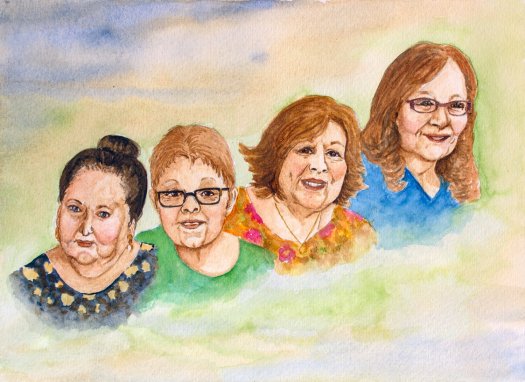
Sofie’s Girls

My family relationships are complicated, but then, that may be true for most of us. I have five sisters and am close to only one, the youngest. I get along OK with the next youngest, but her life is problematic, and I may not be her most sympathetic listener. She struggles with an addiction to pain pills, the same affliction that robbed my son of his life. My efforts to encourage her to seek treatment has succeeded in making her avoid talking to me.

My mother, Sofie, had five daughters, the youngest of which is institutionalized for severe brain damage. My mother had Pleurisy while pregnant and in 1960, doctors did not fully recognize the threat of x-rays to a developing fetus. The sister to whom I refer as my youngest, Linda, has a different mother.

With my other two sisters, Marie and Liz, my relationships are often either strained or estranged. If they had to list which of their sisters they got along with the best, I would place at the bottom of their list. Strangely enough, none of them (Sofie’s daughters) have a relationship with Linda, and I cannot explain why. Her name would not appear on their roll of siblings.

Members of my family treat me like a pariah. That too, I do not understand. I have never done any of the truly hateful and hurtful things to them that they have done to me. My oldest son has not called me in years to say hello while his wife never speaks to me at all. I took this up with my therapist more than once because it hurts me deeply, but I don’t like where it always ends up. Could my sisters honestly be envious of me? My son, Tod, thought so. Tod always said that I was a tough act to follow. I accomplished much in my life and did it despite substantial childhood setbacks. I survived sexual abuse by my father, an alcoholic mother who rejected me, foster homes, and institutions. Yes, I have significant failings. I am damaged. I suffer from Post-Traumatic Stress Disorder, and I do not know how to build and maintain healthy relationships. My daughter-in-law calls this “just a poor excuse” for not being a better mother, but her opinions about my mothering skills came from my son, Michael. He envied and resented his younger brother and called him my “golden boy.”

Without the love and support of my family, I seek validation of my worth as a human being in the things that I accomplish. I earned a Master in Social Work when none of Sofie’s other daughters graduated high school. My sisters resented me for that. For decades, I had to listen to the incessant refrain that I think that I am better than them, and now, I am called one of the “educated elitists.” Sigh!

Thanks to my education, I held better-paying jobs and lived in better neighborhoods. My worst nightmare was that my sons would end up living the life of poverty that I worked so hard to escape. Those fears were unfounded as both of my sons did well. I own two houses, or should I say, I carry mortgages on two! I am in debt, but I have savings as well. Having more money would be a nice thing but my income exceeds my expenses, and I live comfortably. I mention my finances first because this society measures success by our means.

My art has brought me other measures of success. While I am self-taught and most of my work is mediocre at best, I have managed to get a few paintings accepted into museum collections and earned several national public service awards. As a member of a national military affiliated volunteer organization, I received numerous honors as editor and graphic design artist. I need this validation. You see, without the love and support of family, I constantly doubt my worth. I would gladly exchange all of my awards for a family that loves and cherishes me.

My son, Tod loved me dearly, but he is no longer living. I am grateful beyond words to my sister, Linda and her family because they do love and appreciate me. I love them dearly too. For obvious reasons, I am closer to Linda’s daughters than I am to my grandsons. I wish that were not true, but it is. I take comfort in knowing that no matter how estranged Michael is from me, he is a great father to his sons. I wish that I did not feel so alone and isolated, but life goes on. Ω

Escaping From Irma and Other Thoughts

This year’s hurricane season has been awful! Houston was slammed by Harvey in August and sustained severe flooding. Houston received up to 52 inches of rain in just a few days. A month later, Irma wound up the Caribbean and was forecasted to travel up the west coast of Florida. It was one of the biggest storms on record: over 3oo miles wide with wind speeds up to 175 miles per hour; and as I write this and less than two weeks later, Puerto Rico is presently under assail by another category five storm, hurricane Maria.

I planned to stay home during hurricane Irma and hope for the best, but a friend talked me into evacuating. Of course, all of my Facebook friends were urging me to do the same, so the choice between facing down a possible direct hit from a category five hurricane versus leaving along with 7 million other Floridians was an easy one. Evacuate.

The drive out of Florida was arduous. The highways were packed and until we reached Tallahassee, for many hundred mile stretches at a time, we could drive no faster than 25 miles per hour. By midnight we looked for a rest stop to sleep a bit and recover. At the first rest stop I had a wonderful experience; a Déjà vu of memories more than fifty years ago when things like Woodstock, love, and peace reigned. Dozens of people representing every age, gender, economic status and many races stood in groups sharing their experiences. A white man in designer clothing was talking to a Latino wearing faded jeans and a worn shirt. A young woman with several tired and cranky children allowed an old couple to share treats with their children and speak words of comfort to them. The storm was a great equalizer. Skin color, income, and education level did not seem to matter to people sharing a common threat. Unfortunately, George thought this rest stop was too bright and loud and believed that he would not be able to sleep, so we moved on to the next rest area.

One more thing. Florida state troopers (Florida Department of Law Enforcement) patrolled the rest stops, welcomed evacuees to stop and sleep, and directed cars to available parking spaces. They were kind and helpful. In addition to the standard restrooms, every rest stop had many portable toilets set up to reduce wait times.

Finding a hotel room was as difficult as the long drive. Millions of evacuees meant that there were no hotel or motel rooms available in Alabama or Mississippi. We ended up driving all the way to Metairie, Louisiana, a city about ten miles from New Orleans.

Two days later, we drove back home. Many gas stations had either no power or no gas, and the traffic was heavier than when we exited. I was fortunate. The storm veered east. Tampa was not hit by the eye of this storm but suffered only strong winds and heavy rains. I sustained just a few broken tree limbs. While we lost power in my neighborhood, it was back on by the time that I got home.

There are so many other things that I do not know how to talk about. I received a lot of love and support from family members, and I keep wondering why my son never called or texted me to make sure that I was ok. Before we evacuated, I asked to talk to my grandsons, but my son replied by text that he was too busy with meetings and soccer to arrange that call.

Yesterday was Tod’s birthday. He is my youngest son who died nine years ago. I miss him. Tod cared about me and often called me “just to talk” and to let me know what was going on in his life. He enjoyed talking to me and sometimes called for no reason other than to relay a story he knew I would enjoy. I know Tod would have called me before Irma because in 2004 when Florida had four hurricanes, my son came to stay with me to make sure that I was ok. Storms are traumatic events and many times these past weeks, I thought about him. Happy belated birthday, Tod! Fair winds and following seas.


Poems For My Sons

Son-poem

A Poem I wrote over a decade ago for my son, Michael:

The wide-eyed grin of my baby boy
Smiles back at me from pages worn.
A little boy with ball and mitt,
Next older, opening Christmas gifts.

The troubled adolescent frowns,
But other images I own…
A boy building sand castles upon the shore,
Riding bikes, and there are more….

A boy who chased through trees and moors,
A young man who a uniform wore.
Photographs of past loves and loss,
Beside his bride, content and grown.

Now separated by time and space,
Now thrust apart by memories torn,
I miss my son, flesh of my flesh,
I miss his smile and his embrace.

Still, in these pages that I turn
There yet remains the younger boy,
Who can recall the moments when,
He knew that he too loved me then.

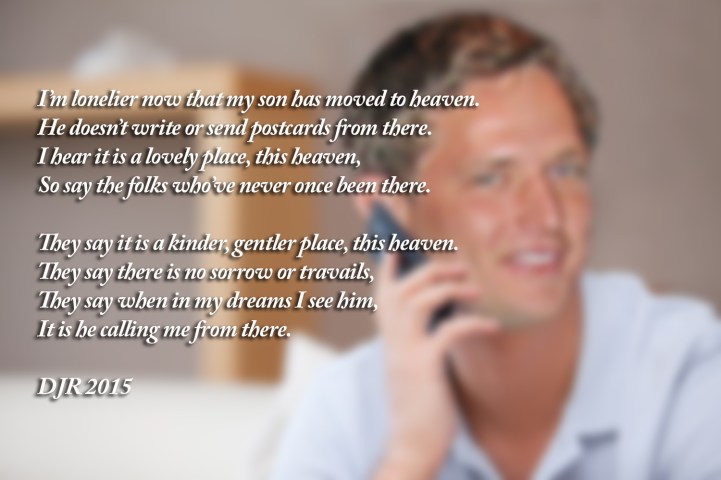
One written for my son, Tod:phonecalls-from-heaven

Phone Calls From Heaven

I’m lonelier now that my son has moved to heaven.
He doesn’t write or send postcards from there.
I hear it is a lovely place, this heaven,
So say the folks who’ve never once been there.

They say it is a kinder, gentler place, this heaven.
They say there is no sorrow or travails,
They say when in my dreams I see him,
It is he calling me from there.

DJR Oct 2015