
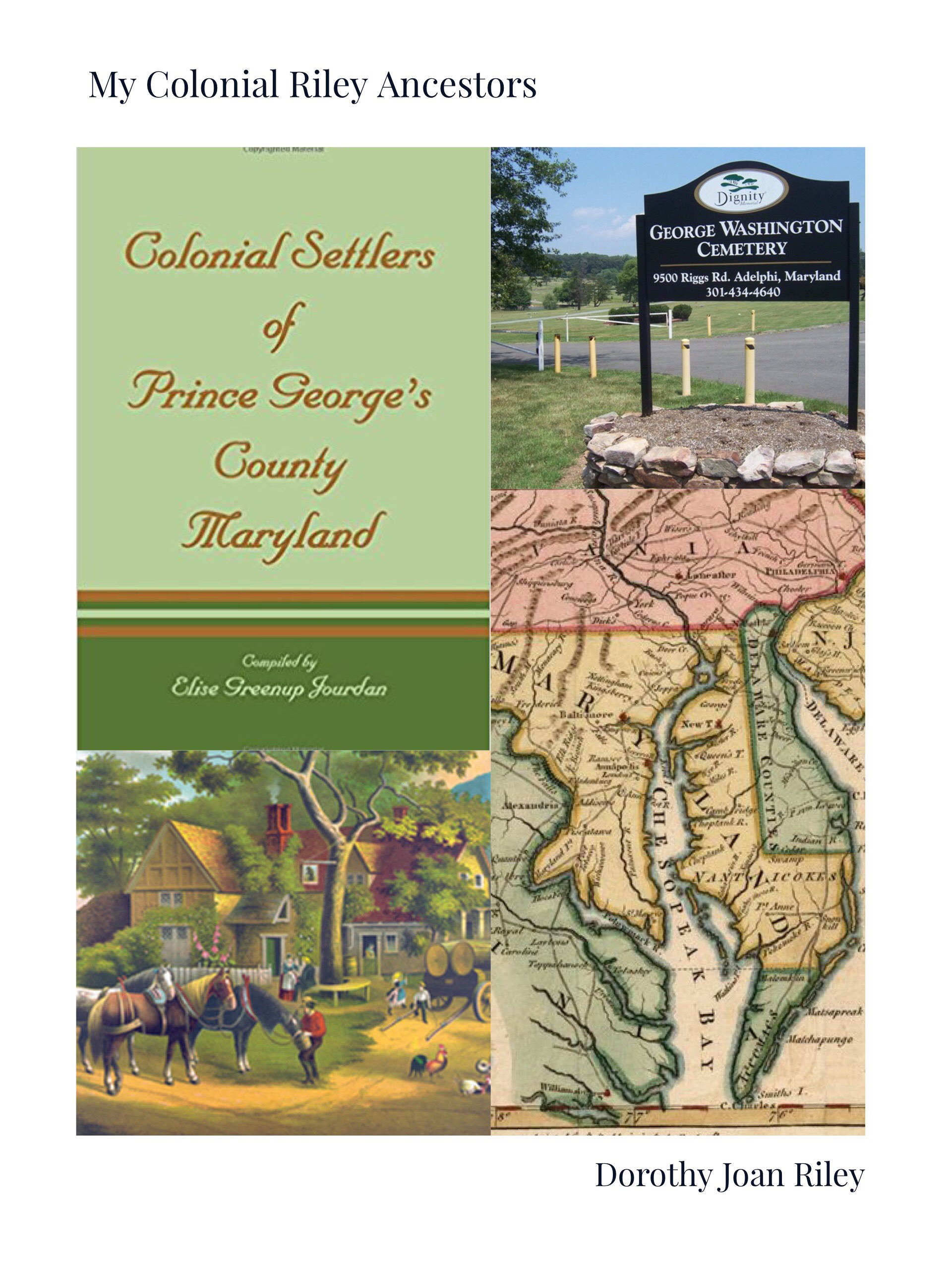
Family trees bring history to life. Those who settled this great nation and fought Indians and who fought the American Revolution are not just people from a bygone era. They are my ancestors- my family. I’ve traced my family tree on my father’s side back to Miles Reilly born 1614 in Ireland, who with his family and son, Hugh Aodh Riley, born in 1650 in Ireland, immigrated to this country and settled in Prince George’s County.
Most Irish immigrants were poor indentured servants and many were Catholics, but Miles was a Protestant landowner and merchant. Why did he choose to leave Ireland? Possibly because Ireland experienced repeated wars between Catholics and Protestants and ruling kings and clans. The new world may have held the promise of peace, prosperity, and adventure. Miles Reilly left Ireland and settled in Prince George County where his son, Hugh, married Margaret Ploumer. Hugh and Margaret gave birth to nine children, all of whom I can only presume were educated because they also became landowners and merchants. Their fifth son, Eliphaz, is my direct ancestor.
Eliphaz was born in 1689. He lived in Prince George’s County all his life. Eliphaz married Elizabeth Burkett in 1714 and had ten children. He is on record as purchasing “the Hop yard tract of land” (land situated between Friendship and the Potomac River). He is on record requesting a license for an ordinary or tavern in 1750 and is listed signing a petition for the erection of a new county from Prince George’s and Frederick’s, which would become known as Montgomery County. He was a member of the Rock Creek Episcopalian Church of England. In his will dated December 8, 1759, he left the Hop yard to the children of his sons James and Jeremiah. Other than these few records, there is very little known of Eliphaz.
What was Maryland like in those years? Prince George County is described as a flourishing settlement with as many as 2,500 residents, a bit more than half of which were indentured servants and slaves. Their lives were almost solely agrarian, and tobacco was the biggest cash crop necessitating a large, cheap work force (hence, the need for slaves and indentures). They did not consider themselves Americans. They thought of themselves as English colonists who swore fealty to King George and the English crown.
I am struggling to picture their farms and farm houses. I struggle to picture them working in the fields, washing clothes and making soap. Likely they did not have to do all of these things themselves. They owned slaves, and landowners were in a class of their own with the right to vote and make decisions for the community. Landowners were invested in being as genteel as possible and dressed their children fashionably, sent them to school and delighted in European art, music, and culture. Despite this, life was difficult. Medicine was not ‘modern,’ and Indians raided remote farms. Daily life could not have been that easy even for the more privileged. I also cannot imagine their reactions when their children swore Oaths of Allegiance to Maryland and fought for independence from England.
By the way, acknowledging their status as slave owners is not a statement of approval. That was their life. Eliphaz’ grandson, Rev. Gerard Riley, was an abolitionist and active in the Underground Railroad. Different times, different values.
 dottieriley
I’m also a descendant of Eliphaz Riley and have wandered (wondered?) down many of the same paths in trying to project what life must have been like. The Find A Grave site for Miles (Maolmardha) Riley has some interesting commentary that suggests that came to there land through policies adopted by Cromwell after the English Civil War. Thanks for sharing.
I too am a direct descendant of Eliphaz Riley. He is my 9th Great Grandfather. Thank you for sharing this.